
It's time for print newspaper publishers in Kentucky to bury their dead and accept the internet is real
And stop calling digital publishers 'bloggers'
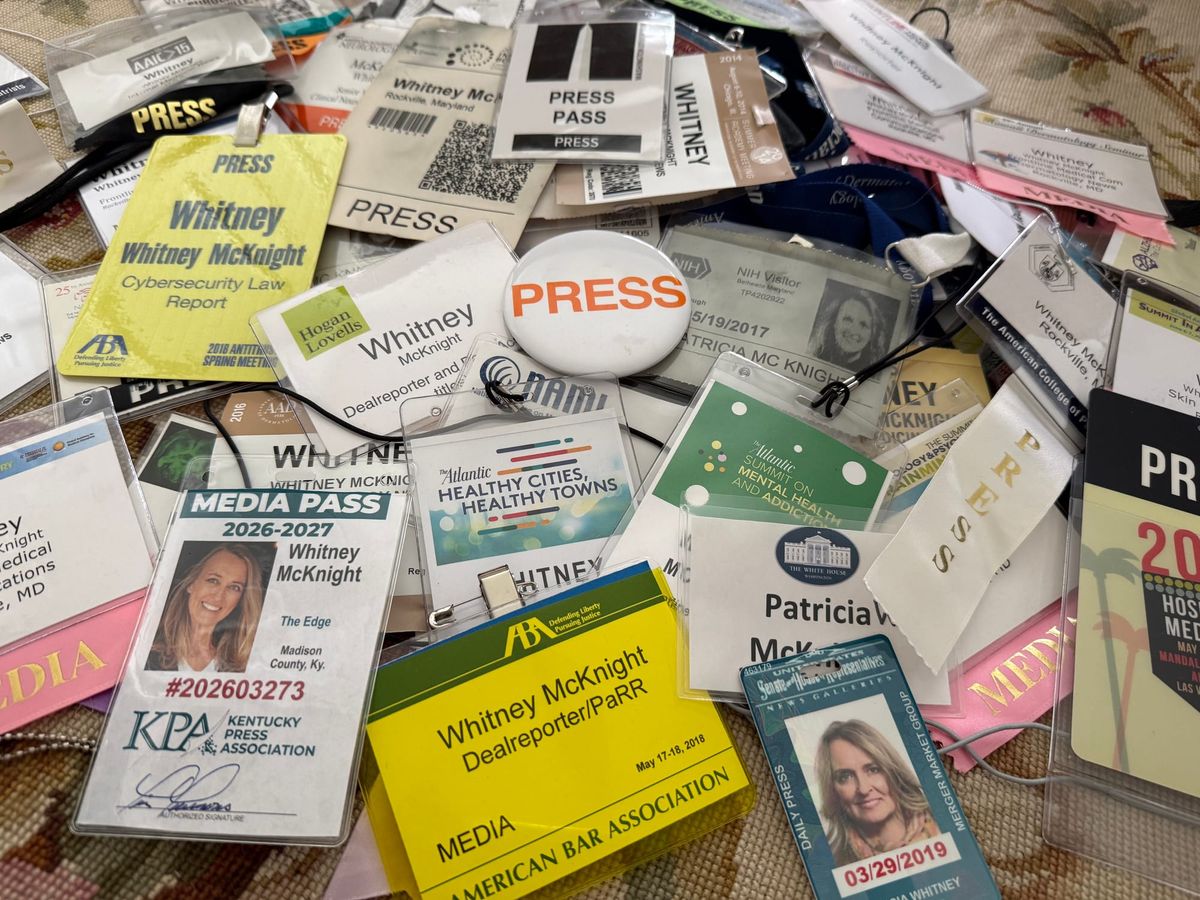
The experts will tell you: Kentucky has suffered a local news crisis. There are multiple reasons for this, but ironically, chief among them are the regressive views held by far too many of those same experts, a host of print newspaper publishers across the state.
They will tell you what killed—is still killing—local news is that Google Ad Sense and Facebook have sucked up all the advertising money, crushing the print papers' capacity to provide news. Social media has also helped suppress subscription rates.
Yes, Silicon Valley tech bros muscling into local markets largely precipitated a news crisis. But that is yesterday's news. Today's news is that there is a vibrant community of digital publishers filling the gaps created in, and even re-defining the boundaries of, the communities where print news in the Commonwealth has cratered.
Far too many print publishers in Kentucky are exacerbating the crisis they bemoan, by not burying their dead and just moving on to find different ways of funding their cause. Or bizarrely, by vilifying those of us who are innovating around the realities of the Digital Age. It's time digital publishers got the respect we deserve from our print colleagues.
This is from a recent article in the Kentucky Lantern: "Newspapers nationally are declining, said Tim Timmons, executive director of the Kentucky Press Association. 'We have lost more than 3,000 papers in this country in the last couple of decades,' he said. The United States today has about 938 printed daily newspapers and about 5,595 local news newspapers overall."
Yes, print papers have either been decimated by lost ad revenues, or they have been bought up and gutted by margin-squeezing private equity investors who use many once proud papers primarily for debt leverage rather than to deliver news.
But here's the thing. It's not just "the last couple of decades" that this has been happening. The WashingtonPost.com turned 30 years old last month. I'll say it again: the 150-year-old print paper's online presence turned 30 years old last month. That is an entire generation. That means, there has been plenty of time for Kentucky's local newspapers to take note, meet the moment, and adjust. And for the most part, they have not.
A prime example of the fear and loathing our state's print publishers have of digital news is their attempt to keep themselves as the papers of record.
A "paper of record" is a term of art with legal implications for citizens. It refers to the media outlet where any sort of legal communication from a municipality or other jurisdiction must, by law, be conveyed. These notices range the gamut from announcements of upcoming meetings where policy will be created or changed, to the date of a sheriff's sale, to requests for proposals, and so on. Public notices are vital to a functioning democracy.
A paper of record is determined according to which outlet has the most subscribers in the readership area where the municipality is located. There are other criteria, such as a minimum number of years in business, a regular publishing schedule, and a focus on local governance.
The Kentucky League of Cities has been fighting for years now to bring the public notice function in-house for cities and towns, so that notifications would only be posted on the respective municipalities' websites.
The KPA meanwhile, has had a lobbyist working for just as many years to counteract the KLC so that print papers continue to be where public notices are published by law. Recently, KPA endorsed the General Assembly throwing a bone to digital publishers to run the notices, but only if they also have a print paper, which really just means that only print papers are still allowed to be the papers of record.
Why does the KPA care so much about keeping those notices in print papers? Because in most cases, those public notices are the only ad revenues the print papers across the state still generate. Put another way, these print papers in the aggregate haven't bothered to find another business model in thirty years.
This is annoying to me as a digital publisher since my publication, The Edge, has more subscribers than the two print papers in either Berea or Richmond/Madison County. That's significant because The Edge hasn't even had much coverage to speak of in Richmond. As for the other criteria a paper of record must meet, The Edge also qualifies, although that my subscription model is tiered and includes free access is problematic to the powers that be.
This print-only arrangement is not unique to papers in Kentucky, to be clear, but there are some states such as New Jersey and Maryland that do allow online papers to be the ones of record. In Kentucky, however, the reactionary policies ensuring information you need isn't posted where you are likely to see it, is reflective of a larger commitment to keeping the state's news industry as a whole economically disadvantaged.
That's because for all the time and energy being spent to cling to those public notice ad dollars like a life raft—and with no guarantee that KLC won't one day prevail—the print news industry could be taking a good look around at what else is happening, like the Woodford Sun has done, for example.
The Versailles-based "legacy" paper will become a nonprofit beginning in September. A "legacy" paper has been defined by someone, I have no idea who, but it is the accepted definition, as a paper that existed before the Digital Age.
The Sun's owners aren't willing to keep losing gobs of money on their for-profit print paper. Why they didn't figure that out sooner, I don't know, but this is exciting and I wish the Sun great success. I wonder, though, did the Sun's owners consider taking their publication entirely online? After all, it is far more cost effective, and is a proven model for news delivery.
When Jack Brammer reported on this newsworthy event for the Kentucky Lantern, he apparently did not ask that question. Instead, while he was heralding a new paradigm in our industry, he did so from within the same old paradigm where sit the Brahmins of How News Is Supposed to Look in Kentucky. Or, as they like to refer to themselves, the "newsmen".
Firstly, the article started with the same old lament about the number of newspaper closures in Kentucky ("a dozen") and in the nation (see above), as if the closures were the news. Remember—30 years. That is old news.
What is actual news is the rise of innovators who are leveraging digital platforms to fill the gaps left behind by the wounded print papers who apparently are more focused on keeping the status quo rather than on the job of delivering essential community news and information.
In Kentucky, there are at least five news outlets Brammer mostly skipped but that I can think of that have arisen to fill coverage gaps: The statewide Lantern for public policy (he mentioned that one), the statewide Queer Kentucky for LGBTQ+ concerns, CivicLex which educates readers about how government works in Lexington and Fayette County, Barrenside in Glasgow for South Central Kentucky policy and government news, and The Edge to cover policy, especially land use, and other government functions in Madison County.
Brammer's article was nearly finished before he slipped in that there are other nonprofit newsrooms in Kentucky which preceded the Sun, although half of the ones he listed are public broadcasting networks (think, "legacy"), and not start-ups that sought to meet the need for news created by the closures or the dramatically reduced service of the print papers that remain.
He also didn't even come close to exploring hybrid models of funding, such as what we have at The Edge. Founded as an LLC in 2024, we've decided to go nonprofit, too, and as we await IRS approval for our nonprofit status, we sell ads and subscriptions while we also accept grant funding under a nonprofit fiscal sponsorship from the Bluegrass Community Foundation.
Then there was this from Brammer's article: "While the non-profit model has rescued many legacy and independent publications, non-profit status is not a guarantee of success. High-profile examples of non-profit news closures include major digital upstarts like The Houston Landing and smaller local publications like the Pike Peaks Bulletin ..."
Some unpacking of The Houston Landing's gross mismanagement of funds, as has been well documented, might have helped, but really what I take exception with is that Brammer didn't bother to interview any of Kentucky's nonprofit news outlets' founders about their actual experience of running a nonprofit news outlet in this state--he might have found that being "rescued" wasn't the only reason for becoming a nonprofit.
Instead, the only "experts" Brammer consulted were the same newsmen who've fiercely resisted digital, nonprofit news—i.e., economically feasible news—until only recently. And because they have no actual experience running nonprofit news organizations, theirs was only theoretical input.
In fact, some "newsmen" still don't even see digital news as "real" news, which might have been why Brammer couldn't see the bigger picture either. There is at least one member of the KPA board who often takes to social media and other channels to lambaste The Edge as a mere "blog", and not "real journalism" specifically because we are online only.
I know from conversations with Timmons and another KPA board member, this is not the sentiment held across the whole of the KPA, but given a lack of representation of the digital publisher perspective in an article meant to investigate novel funding for Kentucky news, it seems the print-is-superior-to-digital trope is alive and well. Plus, when Brammer's article claims that "The state has about 140 newspapers, the majority being weeklies and about a dozen dailies," he is not including my outlet or others like mine. Why not?
The article also did not include the perspective of one of the loudest, and most important, voices speaking about the fate of local news in Kentucky and nationally. How did Brammer not seem to know about Press Forward? They literally have a million dollars they are spending on newsrooms across the US.
If he had known, he surely would have reported on Press Forward Blue Grass's extensive footprint across the state and how they are providing both nonprofit and for-profit models alike with the very kinds of newsroom support that KPA has never offered any digital newsroom because the focus has been on protecting print.
To wit, when I asked to join the KPA, as recently as last year, I was told by the then executive director that I had to have a brick and mortar address, "in case someone wants to walk in off the street and hand you a press release," because I guess this guy thought it was still 1985 (in order to be accepted into the organization, I "borrowed" a business address from someone; no one has ever walked into my friend's office with a press release, probably because they know they can email it to me like normal people do).
Compare that to when I had my first meeting with Press Forward Blue Grass. No one asked about my print or digital status. They just asked what I needed, which was an additional reporter. Within minutes, they offered me access to a fully-funded internship program that allowed me to take on board not one, but four reporters from state school journalism programs. I hired all of them and they are working out great.
The Edge's ability to win more subscribers than the two print publications in Madison County is instructive. Aside from any indication about the quality of our product, I think it helps demonstrate that online—not print—is where people are going for their news and information, and it shows that when outlets like mine apply novel funding mechanisms to our respective business models, the local news crisis in Kentucky is old news and getting older.
Add to this that legacy papers like the Woodford Sun are also beginning to experiment, and it's clear that the real story is that a new day for local news in Kentucky has already dawned, and that it is thanks in large part to digital news publishers, many of whom are fully nonprofit, and some of whom are not. If you hear differently, check your sources. They might just be flogging a corpse and wondering why you're not willing to pay them for it.
Sign up for The Edge, our free email newsletter.
Get the latest stories right in your inbox.
This op-ed has been updated to include CivicLex, and to correct a paragraph out of order.