
What my ICU stay taught me that I want to share with you
Also, thank you to my amazing readers for the outpouring of concern
Dear Friends,
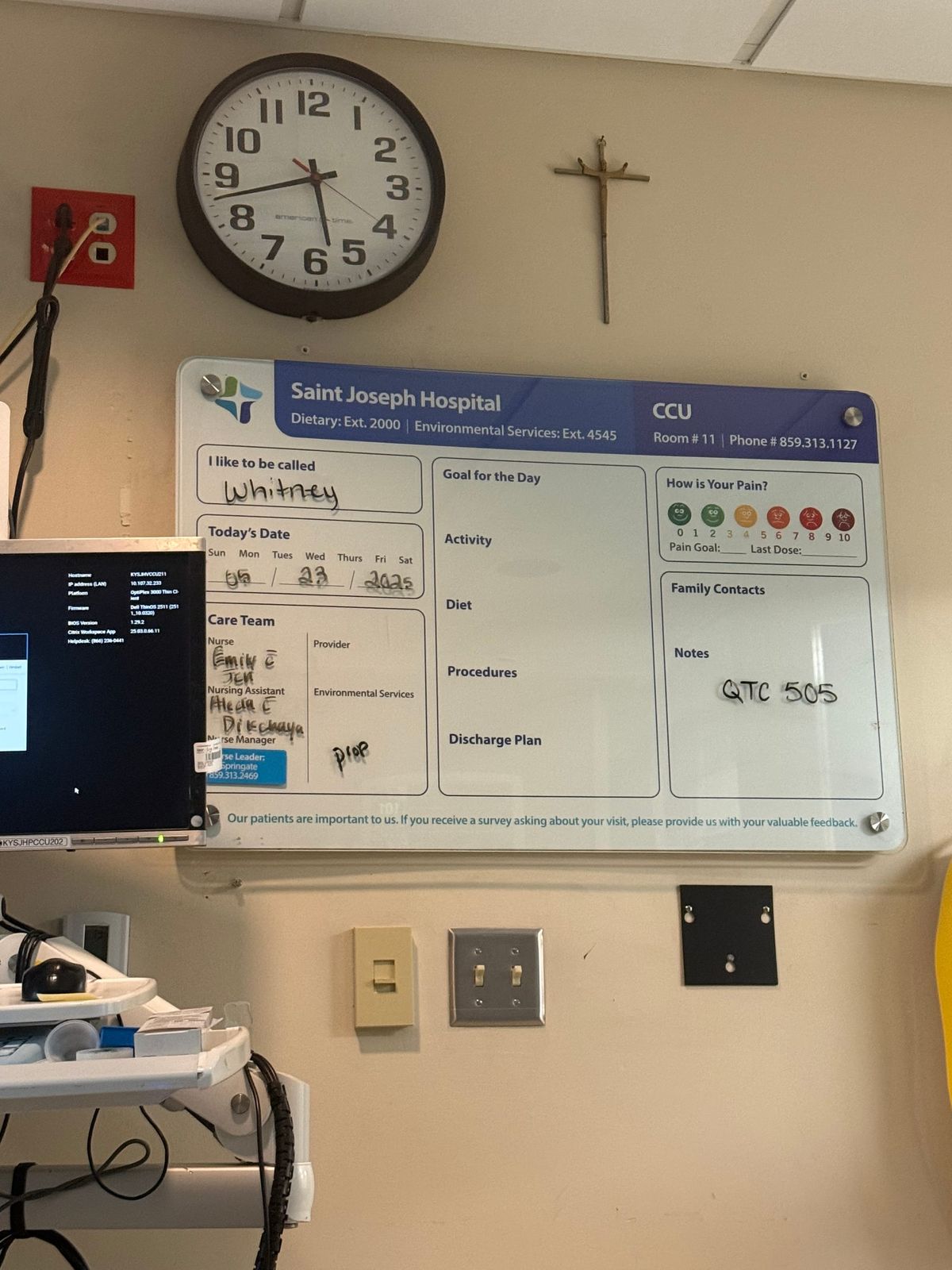
I am no longer in the ICU at CHI/Saint Joseph's main campus in Lexington. I was released yesterday afternoon and am now set up to work from my couch. Thank you all so much for all the messages of concern, and offers to help.
For readers who do not use Facebook, where I posted news about my situation, on Friday afternoon, I believed I was having an asthma attack. I've never been diagnosed with asthma, but increasingly, I couldn't breathe. When I went to see my primary care clinician, she told me I was either having a heart attack or had a pulmonary embolism, and said she was calling an ambulance. But I fought her, and told her that I would be fine.
She insisted on at least giving me an EKG, which showed that my heart was in atrial fibrillation, the condition where the electrical impulse of the heart becomes erratic, and the heart can't stay in rhythm. I'd never had a-fib (as it's often called) before.
I still didn't let her call an ambulance.
I wanted to go home and be very clear about what my health insurance policy would and would not pay for before I allowed myself to be admitted to the emergency room. But no one picked up at United Healthcare. I started to wonder how dangerous my situation actually was, and called my dog sitter just in case I did decide to go to the ER. When she arrived, however, she looked at me and said, "You're gray. Get in the car." She took me to Saint Joe's in Berea. I did not return home for another three days.
Atrial fibrillation
Once in the ER, I was hooked up to multiple IVs with medicines to bring my heart rate down. For two hours, it was parked at nearly 200, and would not budge. So, I was packed into an ambulance and sent to the ICU at Saint Joe's in Lexington.
It wasn't until the next morning that my heart rate started to drop into the 140s. A normal heart rate is about 72. Meanwhile, thankfully, my heart converted to its natural rhythm on its own. Otherwise, I would have been sedated and the medical team would've had to shock my heart back into its normal rhythm.
In my life, I have not ever had any chronic health concerns, except migraines. So, how did I end up with a-fib and also heart failure? Because my thyroid is off.
Hyperthyroidism
Despite having worked most of my career as a healthcare and clinical medicine reporter, I was unaware that when the thyroid is off, the body can be so thrown off, it can lead to organ systems shutting down. And my thyroid was off by a mile.
My doctors still don't know what's causing my thyroid to be in hyperdrive, but they should know soon once my insurance approves the tests to be done. Is it a nodule? Is it cancer? Is it thyroiditis? Oftentimes, the thyroid can become out of whack when there is also an autoimmune disease present.
Even though this chronic condition is not often discussed, it has a global incidence rate of 2.4%, according to the National Institutes of Health, making it fairly common. Most often, it affects women. Symptoms include unexplained weight loss, insomnia, changes to the voice, intolerance of heat, and GI disturbances. Untreated, hyperthyroidism can lead to, among multiple outcomes, cardiac arrhythmias, heart failure, and unintentional weight loss. It also is associated with increased mortality rates.
I had each and every symptom--they had been steadily occurring over the past two years, but I didn't know that collectively, they were trying to tell me the story of my blown-out thyroid.
Common treatments
Once hyperthyroidism is diagnosed, treating it is easy and straightforward. The medicines are generic, and so cost very little each month. Side effects, if any, are also fairly straightforward: headaches and achy joints, if any side effects at all. Because by the time I was diagnosed I had already been in a-fib for several months, based on the onset of my symptoms, I am now on a pharmaceutical regimen to correct my heart failure, prevent stroke, and to help keep my heart rhythm regular. Unlike thyroid medicines, these are expensive, with a one month's supply of the blood thinner retailing for $741.00. I am taking the generic form at $120 per month.
Busted system
Delaying care until I could know what my insurance would or wouldn't pay for is on me and my stubbornness. On the other hand, it's a real concern since insurance companies are deliberately opaque about the algorithms they use to determine what they will and won't cover. In response to the insurance industry's game, hospitals don't tell you what each procedure costs them either. What I will end up owing is still a mystery, but it shouldn't be. Meanwhile, my care team was trying to get permission to give me the tests I actually needed, but were turned down with no explanation.
Once at the pharmacy counter, trying to get my prescriptions filled, I balked when I was told the total, followed by the pharmacist's suggestion that I go online for a discount card and find the cheapest pharmacy. That's when I learned that any American who needs recurring prescription medications enters into a game where they must figure out which pharmacy has negotiated the lowest prices with distributors for the particular drug that patient needs.
For example, Walgreens would have sold me one of my heart failure medicines for $48, but they were out of stock. They transferred by prescription to Walmart, where I bought it for $120. For many families that is a huge difference that "smart shopping" can't do a thing about since they have no control over inventory. Yes, I learned about the GoodRx card in the process, the discount card that you can get for free, or pay $15 a month and get really good discounts, but the same variables exist with or without the card.
And it's a load of horse hockey.
Those savings should be passed along straight to patients, not make them have to drive all over town waving a discount card issued by some middleman that is making money off the price discrepancies.
The amount of shucking and jiving that we are exposed to and have to participate in so that the insurance-pharmaceutical industrial complex (and also some hospitals) can keep their so-called "trade secrets" hidden can't go on forever. And in the case of CVS/Caremark, they own every point in the distribution system, so they are just self-dealing.
Permit me a little more ranting: America can't keep producing crops of sick humans for these industries to farm and harvest. Eventually, we the people are going to run out of money to support this system. We are the only nation where we pay exorbitantly to enter into a game where the rules are that we have to go on a scavenger hunt if we want the care and treatment we are supposed to have to heal. If we could actually see the cost vs. the profits made by the insurance-pharma executives, I am sure that it would really make us sick.
Excellent care
Even though our healthcare system is designed with evil in mind, where profiting off of people's misfortune is the point, while in the hospital this week, I was once again reminded of how the people who work within this system are operating from a different set of values.
I spoke with several nurses and physicians while I was inpatient, waiting for my rhythm to come back to normal, and learned that they feel called to take care of us. It's hard to ignore a call, but it's perhaps harder to hear it, respond to it, and then work in a system where the moral injury to work according to the values of that call is great. By that I mean, the injury to their sense of what is right vs. wrong when they see how people are treated as widgets to profit from by the systems these medical professionals must work within.
They are strong people to be able to endure that schism between themselves and the larger system and still perform so well on behalf of their patients. I was given such excellent care, and always with a smile, by every single nurse and doctor both here at CHI Saint Joe's Berea and at the Lexington campus. I also believe that my primary care doctor at White House Clinic helped save my life when she said that if I didn't address my situation soon, I might end up unresponsive, and then things would go downhill from there.
Thank you
The burst of love, care, support—including the offers to drive me where I needed to go, to care for my dog while I was in the hospital, to provide meals, to do whatever I needed—were so numerous and heartfelt, It occurred to me that this community has claimed me. It really was something to be so showered with so much love and care. The nurses were taken aback by how many visitors we fit in that little ICU room, lol.
Consider this your public service announcement about hyperthyroidism, and a reminder to listen to the stories your body is trying to tell you, and also, maybe speak up when you are inconvenienced by a healthcare—or any—system that we're told is designed to serve us, but clearly serves anyone but us.
Now, it's back to work, and thank you for all that you do as part of The Edge community.
Take care of yourselves,
Whitney
Sign up for The Edge, our free email newsletter.
Get the latest stories right in your inbox.