
When our elected leaders say they support property rights, ask them what they did to help protect the Gabbard farm
It’s up to us to keep our leaders accountable
A few readers have asked if I will be endorsing any candidates. No. I think endorsements are patronizing, for one thing. Voters do not need a nanny looking over their shoulder at the polls. Endorsements are also counterproductive since they tend to be partisan, and news outlets are supposed to avoid that.
So, no endorsements here. But ahead of the primary, I would like to examine an important eminent domain case underway in Madison County, as I believe it has bearing on the election, and on our understanding of what our leaders mean when they speak of property rights, which members of the Fiscal Court in particular often do.
Constitutional tyranny
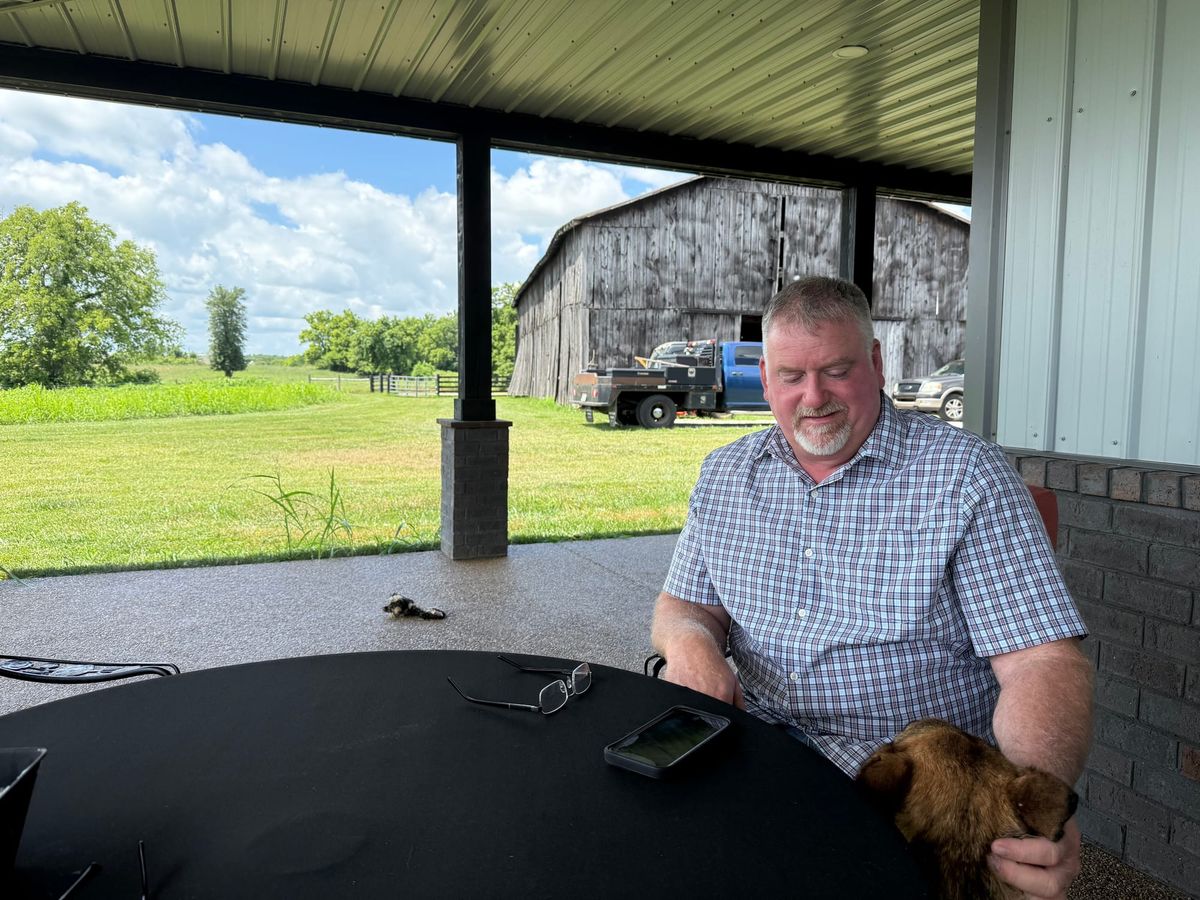
In the annexed agricultural area of Richmond, near the Madison County airport is where farmer Scott Gabbard has more than once asked me if he is losing his mind, going crazy, seeing connections between events that don’t exist, all while he seeks to protect his farm from eminent domain.
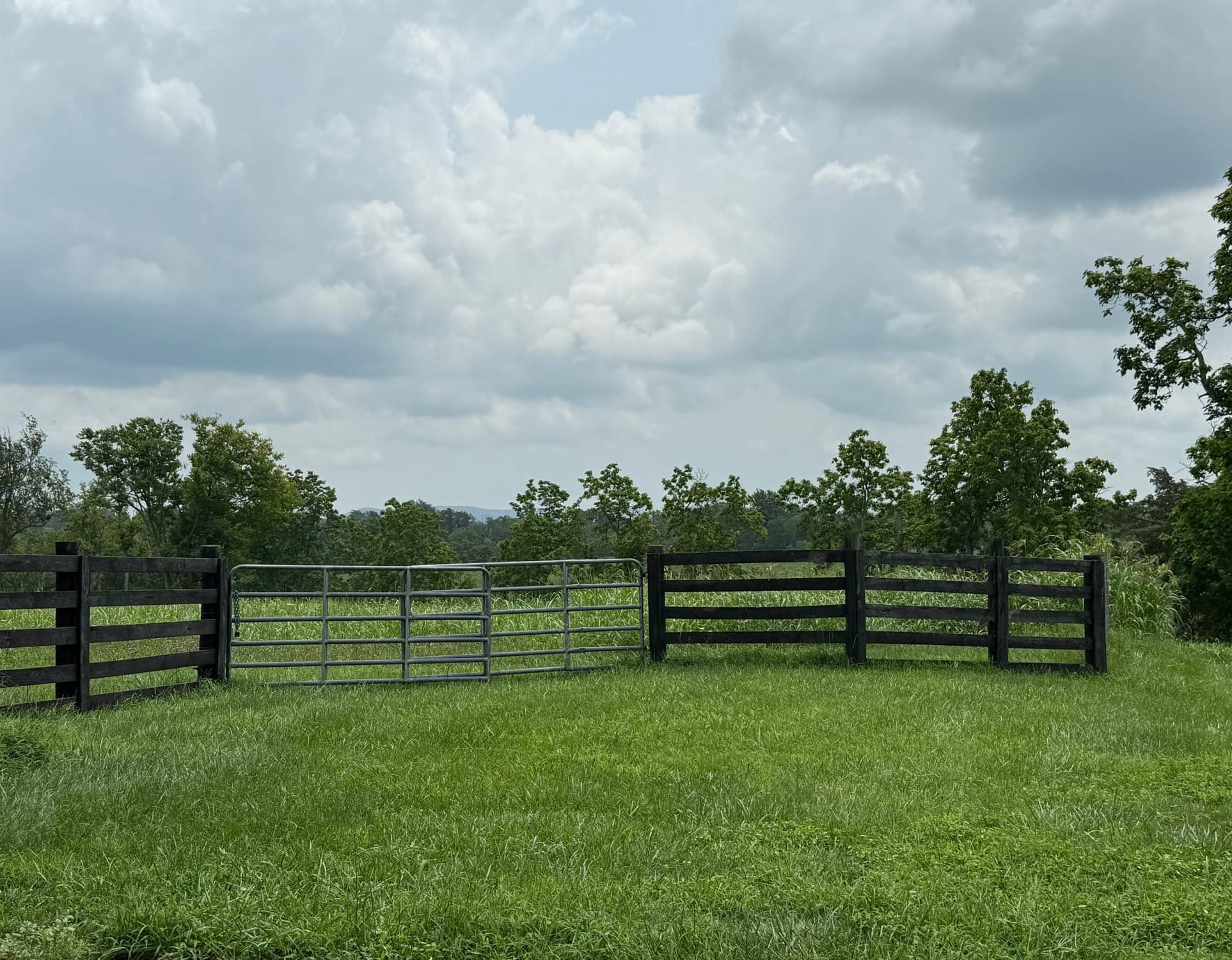
Gabbard tends about 150 acres off of John Ballard Road where the state wants to cut through his farm to build a road and a massive bridge over Silver Creek, in order to connect the airport to Duncannon Lane.
I worry less about Scott’s mind than I do his heart. He claims that after everything local and state officials have put him through, he has lost years off his life span. Sadly, I believe him.
I have observed over my life that working with the land creates an intricate relationship between it and the person who works it, a bond that is intimate, and nourishing to the soul. But our landtaking system does not account for the harm caused when an outside force destroys that human-land bond. The taking is simply seen as a transaction. This is rarely a willing transaction, however. Eminent domain tends to happen under duress, leading to heartbreak for those who have lost what they loved. There is no fair market remedy for grief.
Given the hyper spasm of growth our county is now experiencing, the sanctity of property rights for Scott seems dubious. That’s because the profit-motive lens on land has created a sickness in our county, although certainly everywhere else, too. But here at home, and in particular with the Gabbard farm, this money sickness appears to have led our elected and other officials to callously view eminent domain not as the weapon of tyranny it actually is, but as a way to make a profit at a farmer’s expense.
What I am saying is that Scott has been devastated by the threat to his farm, and while there are those who could have advocated on his behalf, they did not. In fact, it appears they advocated against him.
Loss in court
Gabbard’s life-long dream was to be a cattle farmer. He did not inherit the lush rolling hills he now farms between the county airport and Duncannon Lane. Instead, he worked as an electrician for years to purchase it, and once he had the deed about 13 years ago, he worked the land to help it support his dreams and his family. But he also worked according to conservation guidelines in order to give the land what it needed, too.
In so doing, he developed a relationship with the patch of beauty that includes a glistening creek lined by hardwood groves, a small valley between the dramatic rolling hillsides dotted with wildflowers in summer, and a cliff overlooking Silver Creek and the Ramsey cattle farm beyond.
Scott and his wife, Angela, did not accept the state’s so-called fair market offer for the dozen or so acres it wishes to take and so the two parties landed in court last August.
The state’s offer was barely six figures, even though the Gabbards will lose not just the 12 acres, but the use of dozens more. That’s because the road will divide Gabbard’s pastures, rendering the western portion of his farm useless, because how can a farmer drive his cattle across a 55 mph road, which is what is intended to be built there. Plus, a road will now be at the Gabbards’ back door.
Who would want to live there if the Gabbards tried to sell in the future? Think about the noise, too, that is, if the state’s promised traffic ever does arrive. Currently, you could picnic on John Ballard Road and not be disturbed most hours of the day.
In the end, Madison County Circuit Court Judge Kristen Clouse made a point to declare that she was limited to ruling according to statute and precedent, before deciding that the state could take the land. The Gabbards appealed and now their case is making its way through the appellate court in Frankfort. Likely, ruling will come in the summer of 2027.
Federal dollars for road
Who wants this road? It depends on who you ask. Over the course of the past year as I investigated this story, whenever I would put that question to people in power across the three local jurisdictions, the first answer would always be that the road was for EKU aviation students who needed a safer road to travel to the airport. Admittedly, Caleast Road/State Hwy 2881, the road that currently connects the airport to Duncannon Lane, is treacherous. But there haven’t been any aviation student fatalities, and they could take I-75 to Exit 77, and follow the newly widened and very straight Peggy Flats Road to the airport in about the same amount of time.
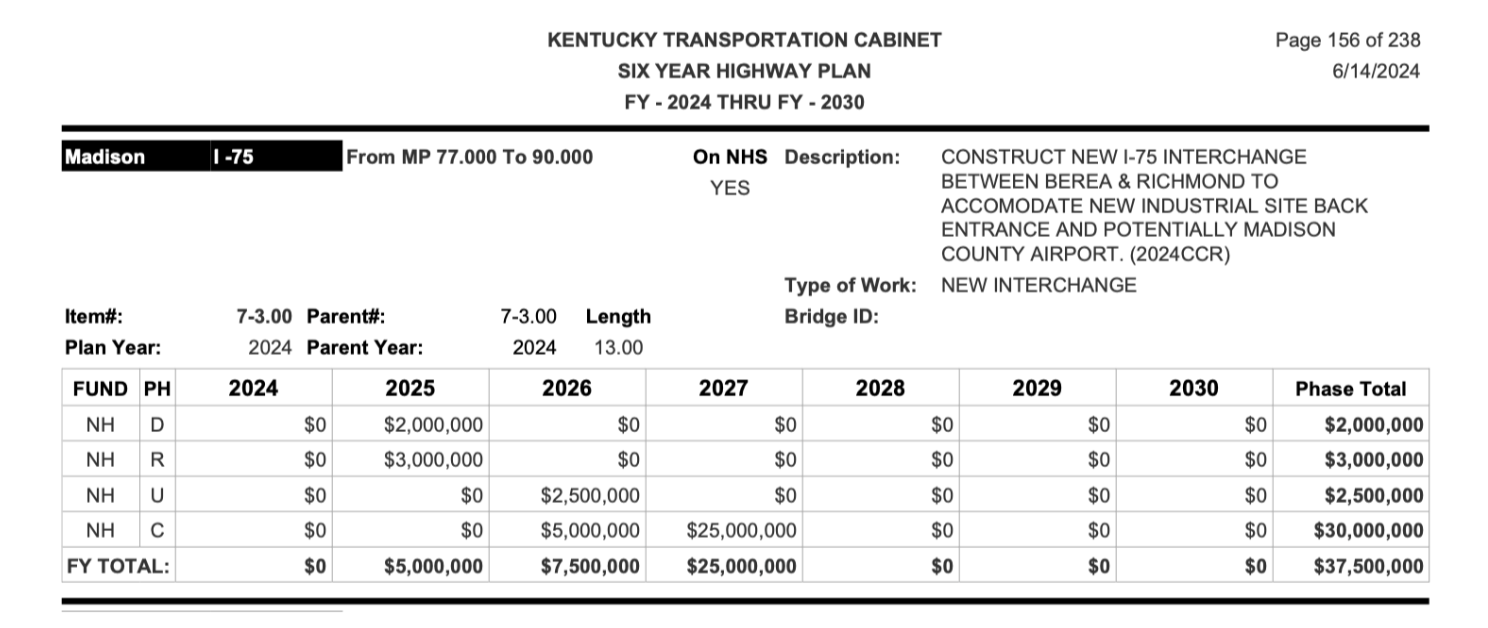
Or, we could call off building a new road altogether and wait for the new interchange KYTC plans to build specifically as an airport exit, as detailed here in the Six-Year Highway plan 2024-2030:
County Judge Executive Reagan Taylor told me on the record last summer that the road’s origins can be traced back maybe 15 years, to discussions at the Blue Grass Area Development District, an unelected regional agency that decides economic development priorities for the General Assembly to attend to in the region, roads in particular. I asked several BGADDers about it, but no one claimed to remember anything useful.
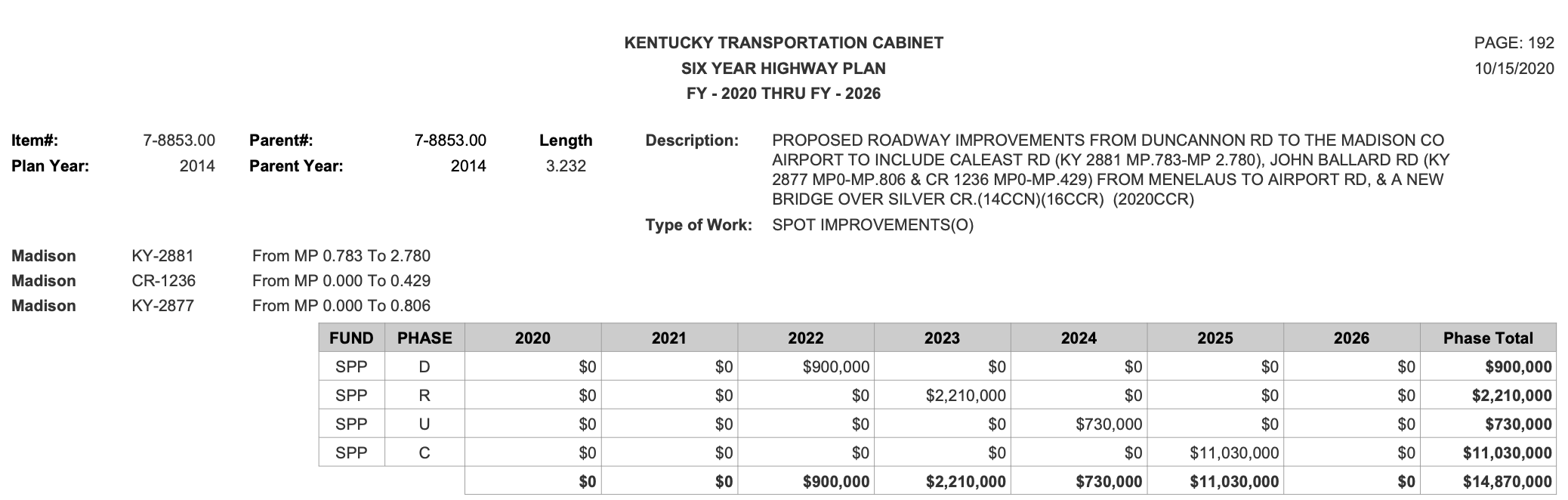
Documents from the Kentucky Transportation Cabinet, however, suggest that at the state level anyway, an outright new road wasn’t on the table anytime through 2026. Prior to that, the state only planned to do “spot improvements” to Caleast.
But in April 2021, the road was becoming a priority for some as evidenced by letters written to Congressman Andy Barr by local officials. The letters also indicate plans for the project emerged from the Fiscal Court and a range of others, including Berea, Richmond, EKU, the airport board, and even the Richmond Chamber. This happy statement from Barr’s office features ecstatic quotes about the road from leaders at each of these entities.
A letter to Barr from Magistrate Tom Botkin (Dist. 4), dated April 27, 2021, on behalf of the entire Fiscal Court, asks for federal money to build “Economy Road” from the airport to Duncannon Lane.
Botkin’s letter reads: “This project will create an unprecedented impact on our community by creating a safe route for citizens, including students of our EKU aviation program, new sites for businesses to locate, an alternative route to ensure commerce continues when delays and rerouting from the interstate occur.”
The italics in the above excerpt are mine. That’s because the words seem to presage the destruction of the Gabbard farm, or some property owner’s land—the Gabbard property sits between the Begley Property and the Ramsey cattle farm—for the sake of development.
That leads to another important question: when did the road’s proponents begin to see in their mind’s eye that the road would cut through the Gabbard farm specifically? Whenever it was, that would have been the start of the county making plans for development.
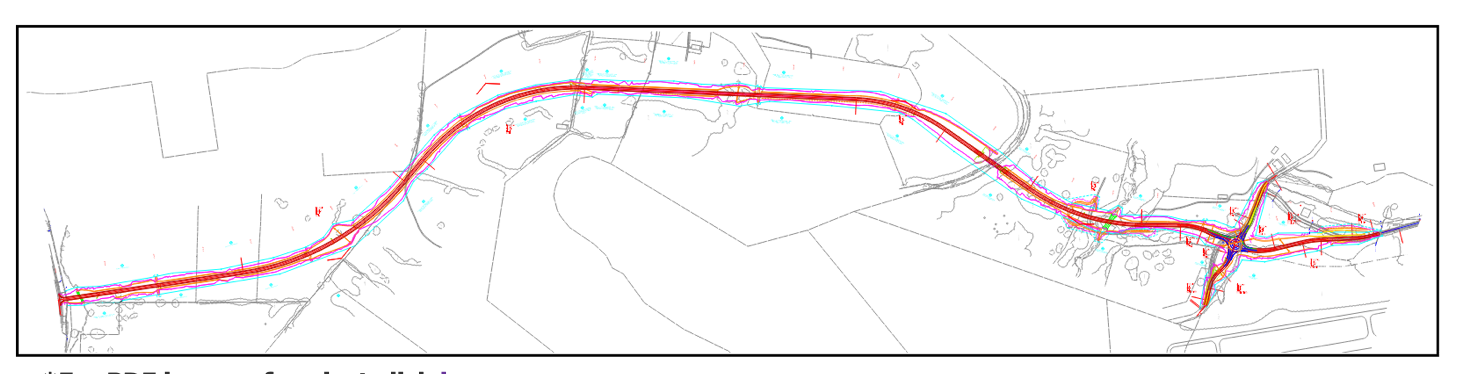
Taylor maintains it was the state who ultimately made the decision to put the road where it is planned, not the Fiscal Court. And that the decision to site it through the Gabbards’ land was based on what the engineers thought was best, not in order to favor one property owner over another. “It had nothing to do with any one property owner, it had nothing to do with it,” Taylor told me last month in a sit-down interview. “It was, we need a new pathway. I’m not an engineer or a road designer.”
Meanwhile, another letter, this time from Berea Mayor Bruce Fraley, written on April 21, 2021, the same timeframe as the one from Botkin, also asks for federal dollars to help build a road that connects the airport to Duncannon Lane. “This rural infrastructure improvement is critical to our entire county and to the regional economy,” Fraley wrote.
In October, 2022, Barr announced he’d landed $5 million federal dollars for the road. He cited safety concerns for the EKU students, but emphasized the road’s role in development across the county. “The Economy Road project is a project with much community support that is part of a bigger strategy of recruiting and retaining business investment in Madison County,” Barr wrote in his project funding memo for 2022.
"Much community support" should be qualified. It had "much" support within the economic development crowd, but residents of Madison County are generally dismayed by the pace of development countywide, and there was no outpouring of public support for this road.
My takeaway from these letters and Barr’s description of the project is that EKU aviation student safety might be the lead item, but is not the actual priority of this road. It’s called Economy Road, not Safety Way. Clearly, this road is intended to expedite development in the county, and the airport's role in that development. Incidentally, the airport is managed by EKU.
Presumably, it was the federal funding that forced KYTC’s hand to reprioritize the project from the bottom third to the top third of its highway projects list. Construction was to have already started on Economy Road this year, but for the Gabbards’ appeal of Clouse’s decision.
In any case, if KYTC were to move on this project, word would have had to come from our state delegates, Sen. Jared Carpenter and Rep. Deanna Gordon. Now that there was federal funding, they would have to be the ones to procure state funds for the project, too. I tried but failed to make contact with either one of them. I also tried and failed multiple times by phone and by email to confirm that Gordon told Scott when he’d asked her to help him fight the road, that he was just being a NIMBY (“not in my back yard”). Lordy, if that is true, talk about tone deaf. Of course Scott is NIMBY. The road literally will be in his back yard.
Spot improvements v. new road
Taylor and Gabbard both agree that they discussed the possibility of the road coming through the Gabbard farm sometime before 2020. This fact again makes me wonder exactly when officials started envisioning the road through the farm, but Gabbard tells me that he didn’t take Taylor seriously at that time because the state’s website said the plan was just those “spot” improvements to Caleast Road, as well as to John Ballard and Menelaus roads. Gabbard also told me that he thought that because the airport was small and there was so little traffic on John Ballard Road, that Taylor had to be wrong, and KYTC had to be right.
But soon, things changed dramatically. The airport’s profile went into the ascendent, as I previously have reported. In 2022, when Gov. Andy Beshear began in earnest to flog Kentucky as the world’s manufacturing hub, the number of landings of private jets carrying C-suite individuals from multi-national and other companies who wanted to inspect the regional industrial sites, began to steadily trend upward at the airport. Today, Madison County Airport is ranked among the top two busiest general aviation airports in the state, second only to Muhammad Ali International Airport in Louisville (Bowman Field).
There has also been a large bump in the numbers of students enrolled in EKU’s aviation program, the state’s only 4-year aviation degree program, as word got out about its cost value. Additionally, money has been pouring into the airport from various federal and state sources to update and expand the airport.
And this month, there was the groundbreaking for a regional business park in Berea. Last year, the County put an option on 800 acres for some kind of yet-to-be-determined industrial endeavor near the river. And the approximately 1,500 acres of the Begley property is still on the industrial market.
The rich v. eminent domain
Before the state settled on building the road through Gabbard’s farm, it called a public meeting in order to explain the project. Residents of the area were asked to choose one of three options for the new road. Improving Caleast was off the table, since the state had determined that to widen it would be cost-prohibitive.
The public's options were: a road further west of the Gabbard farm, through the Begley property; another through the Ramsey’s cattle farm—which the state did not disqualify even though multiple Woodland Indian artifacts were discovered there when surveyed—and a third through the Gabbards’ farm. But notably, as shown in the animation below, all three roads options would go through some portion of the Gabbard farm.
The public chose the road that will do the most damage to Gabbard’s farm. For the other two property owners, the road would either skim the property's edges or provide road frontage useful for development.
It would be helpful to see those public responses, and I am working on doing so. The reason that I can't shake wondering about them is due to something a lawyer told me last year when I first began reporting on Gabbard’s fight to preserve his farm.
“The rich never have to deal with eminent domain,” attorney Robert McNamara, an eminent domain specialist, said.
In this case, the Begleys and the Ramseys are among the wealthiest land owners in the county. They might have done absolutely nothing to enjoy the perks of the new road, but they will likely benefit from it, and they will have lost nothing for their gains.
That is what bothers me about this case: I see it as a blatant land grab from one viable private enterprise in order to enhance other private enterprises, including those future businesses that have yet to be developed. Taking from one private individual to benefit another private individual did not used to be an acceptable interpretation of the Takings Clause, but thanks to the Supreme Court ruling in the 2005 Kelo V. New London case, this sort of abuse is now legal.
Justice Sandra Day O’Connor wrote the dissenting opinion in that case. Reading it, I thought she might as well be describing Gabbard’s predicament: “Under the banner of economic development, all private property is now vulnerable to being taken and transferred to another private owner, so long as it might be upgraded—i.e., given to an owner who will use it in a way that the legislature deems more beneficial to the public … The beneficiaries are likely to be those citizens with disproportionate influence and power in the political process, including large corporations and development firms. The Founders cannot have intended this perverse result.”
Choosing our leaders
All this to say that if our locally elected officials are going to say they champion property rights, they need to be as specific as possible. Where the Gabbards are concerned, their efforts around property rights look more like thievery than heroism, even for those who have said they do not support eminent domain. Here was their chance to demonstrate that, and they failed.
Like I said, I do not write endorsements, and this is not a call to oust every incumbent. Our situation in the County is not that cut and dried. There are many things that our current roster of officials should be commended for doing well. On the whole, they are fiscally responsible, they appreciate our community, and they are committed to the age-old city planning maxim that if a jurisdiction isn’t growing then it’s dying.
I applaud their commitment to bringing in jobs and other economic development projects, but with all this sudden growth, “Grow or die!” is not the maxim many in the county want to live by, and that is why many County residents are upset.
And yet. While on the campaign trail, I heard a lot of emotion and a lot of negativity. But what I did not hear from non-incumbent candidates was a solid plan for addressing these economic development issues, and I especially did not hear anyone demonstrate a grasp of how infrastructure issues arise, what mechanisms are available to address them, and how such solutions are funded. All I heard was stop the growth and build up the infrastructure. With what money?
The finer points of municipal government can be learned, and there are many classes offered by the Kentucky League of Cities and the Kentucky Association of Counties, but if you disagree with the causal but legal property theft that is happening to the Gabbards, and want to make things right, you need a strategy. A strategy requires a clear idea of how things work and a value system that supports how you will set things in motion. I wish I could say I heard anyone offer that.
Something I learned nearly 30 years ago when I covered my first land use story is that whoever owns the land holds the power. Without exception. According to KREF, among the largest donors to at least two of the three Judge Executive candidates are among the wealthiest land owners in the county: the Grants support Taylor, while the Ramseys support Donna Agee. As of May 17, Chuck Givens' largest contributor is anonymous. I'd ask him about it, but he blew off several invitations to be on my podcast.

I’m just saying that replacing the faces in our halls of government isn’t a foolproof way to end the influence certain wealthy people are likely to have. It’s up to us, the electorate—not our elected officials—to be the ones who hold our elected class accountable. Yeah, it’s hard work. Welcome to democracy.
PROPERTY RIGHTS
To say “no kings” in 1770s America was to affirm the right of men to own land, guns, and other personal property, without paying taxes on them to an absent monarch. Thus, property rights are at the heart of our nation’s reason for being, but as a system, it is fallible.
For one thing, to view land as mere “property” negates its more enduring value as the ground that supports us all while inspiring us with its beauty, and regenerating all the resources we need to live, resources that when we do not interfere, are offered by nature to us all and in abundance. For another, there is eminent domain.
Landtaking is Constitutional, requiring only that the land owner be paid fair market value in a “public good” exchange. But I note with interest that the Fifth Amendment’s Takings Clause is void of the soaring language elsewhere in the Constitution, such as when describing an individual's right to pursue happiness as one sees fit.
Instead, landtaking in our founding document is treated as a fact of life. And yet, John Adams said, “Property must be secured or liberty does not exist.” How did the Founding Fathers reconcile the fact of eminent domain with Adams’s sentiment, I wonder. ~Whitney McKnight
Sign up for The Edge, our free email newsletter.
Get the latest stories right in your inbox.