The players vs. naysayers in deal to turn Carr farm into regional business park
An exclusive investigation: Is interlocal collaboration a key to innovative economic development for all, or a window on the world of a self-dealing political class?
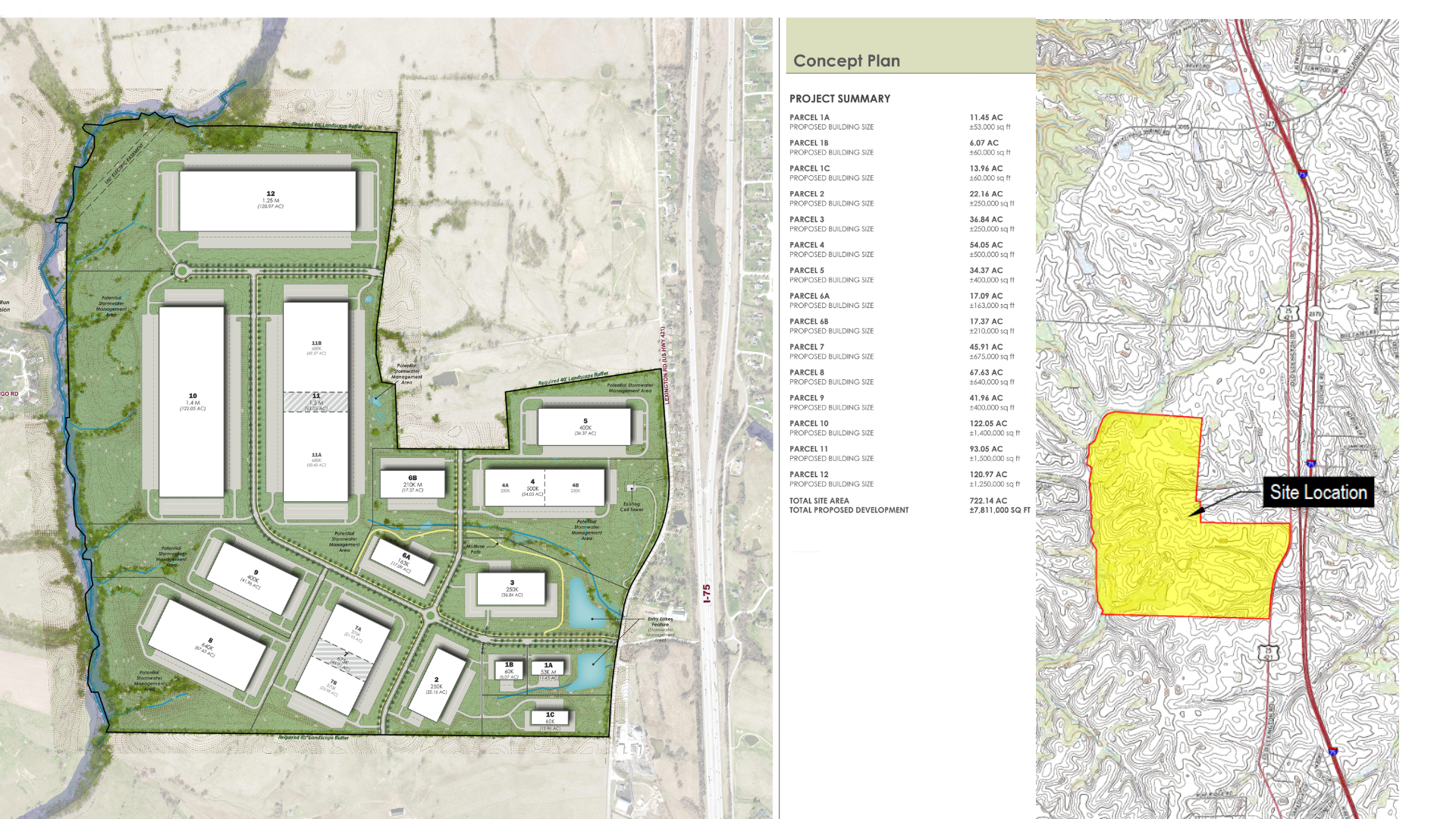
MADISON COUNTY—In total, there are 722.14 acres. The appraisal lists six discrete, adjacent plots of agricultural land on the western side of Lexington Road, two miles north of Richmond. The lots are priced as one parcel for $19 million, or $26,250 per acre. Noted in the appraisal is that the price is high only if the land is to be used as a business park. If it were to stay a farm, a new price would be set.
For years, the Carr property has been leased by a big operation cattle farmer for less than $50 per acre annually. There is also a cell tower on the property, now in its second year of a five-year lease, currently valued at about $12,000 annually. Evidence is scant that the Carr siblings, who recently inherited the land, had intended to sell the property to commercial interests before the Madison County Fiscal Court placed an option on it a year ago. At least, the farm wasn't listed on the open market.
Just days after the purchase agreement was signed, the Fiscal Court transferred it to the Central Kentucky Business Park Authority. Madison County Judge Executive Reagan Taylor has been deputized to handle the negotiations on the Authority's behalf.
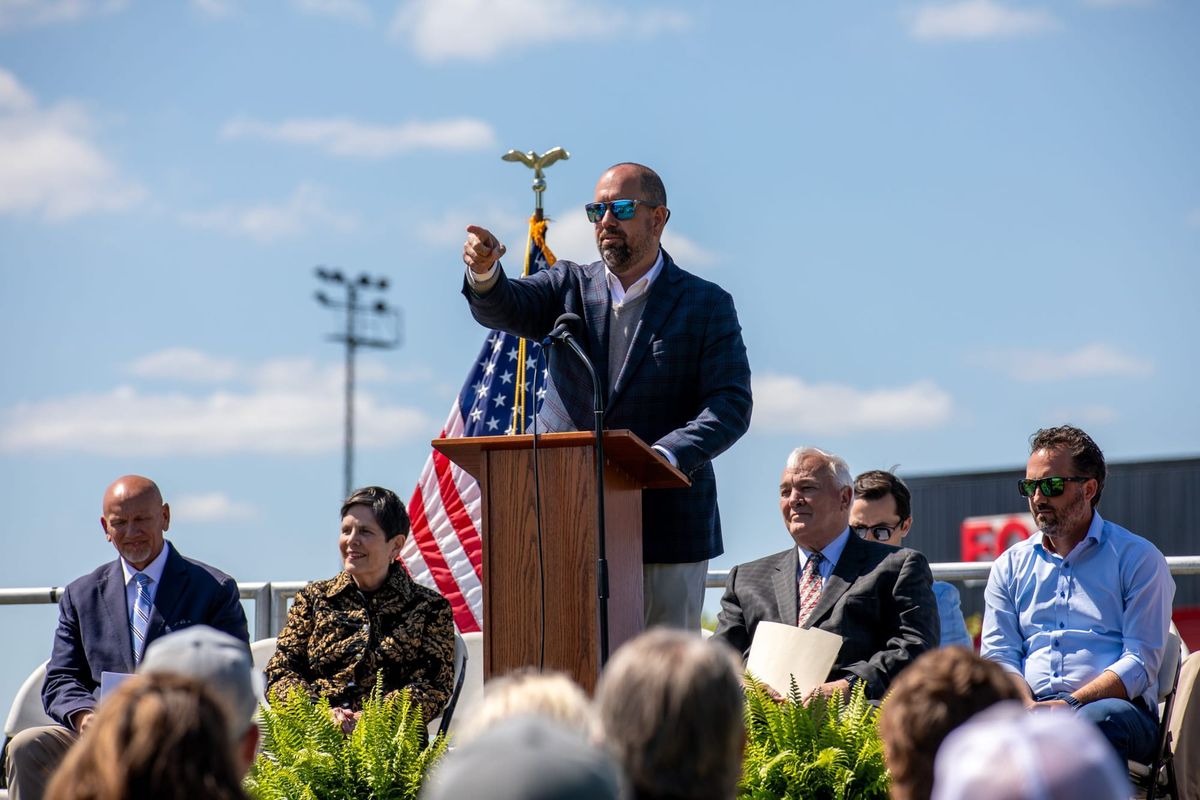
The CKBPA was created in 2024 as part of a novel regional economic development initiative via an agreement between Madison and Scott counties, the Lexington Fayette Urban County Government, and the City of Berea.
The premise is that by pooling resources, including available labor, and building a series of interrelated business parks, the region will attract bigger and better economic development opportunities than would be possible if the jurisdictions were competing with one another for any opportunity.
"Businesses don't care about county lines or city limits," Scott County Judge Executive Joe Pat Covington said in a promotional video about the CKBPA. "They want a spot that is close to the Interstate that has a good workforce," he said.
Controversy has dogged the model since its inception. The City of Richmond had been slated to participate in the agreement, but citizens shouted it down and the Richmond City Commission withdrew its support for the plan. The same thing happened in Georgetown, which also withdrew from the agreement.

Aside from there being broad opposition to large parcels of picturesque, fertile farm land being covered in concrete, another concern often expressed by critics is that this scheme does not promote transparency, a feature of local government many in Madison County feel is already lacking, especially in the Fiscal Court where they say builders and others with ties to development have found favor.
Opponents also say regionalism places too much land in the hands of people unaccountable to locals, making it difficult for them to participate in the conversation around regulating the activities of the respective business parks.
In Berea, about 300 acres already are under management by the CKBPA. If the Carr farm sale goes through, it will bring the total County acreage under the control of the regional agency to roughly 1,000 acres.
"That's a thousand acres the County is giving up control and ownership of," Mary McMahan, a Madison County resident and frequent critic of the Taylor administration, told The Edge in a text. "Also what happens when a representative resigns, dies, or moves away—who appoints their replacement?"
The answer to that question, according to Berea Mayor Bruce Fraley, is the CKBPA Board of Directors, which is comprised of one member per participating jurisdiction, appointed by each jurisdiction's elected leader.
Other objections include that the interlocal agreement wasn't given enough public air time before it was signed off on by the County. "I watched every [County] meeting from March to July of 2024 and the interlocal agreement never came up," Savannah Westerfield, another County resident and Taylor critic, told The Edge in a text.
The County did post notice of the deal in a special called meeting agenda on October 17, 2024, but did not hold a public forum. The Edge was not in operation at that time, and so was unable to cover the implications of the agreement.
"We didn't even know about the possibility until the Fall of that year when it came out that the Fiscal Court was sending money to Scott County," said Westerfield.
In fact, the regional deal that would have had money go to Georgetown in Scott County fell through in November 2024 after the public discovered it would mean developing a beloved historic farm along Elkhorn Creek for the jurisdiction's contribution to the Authority, among other objections.
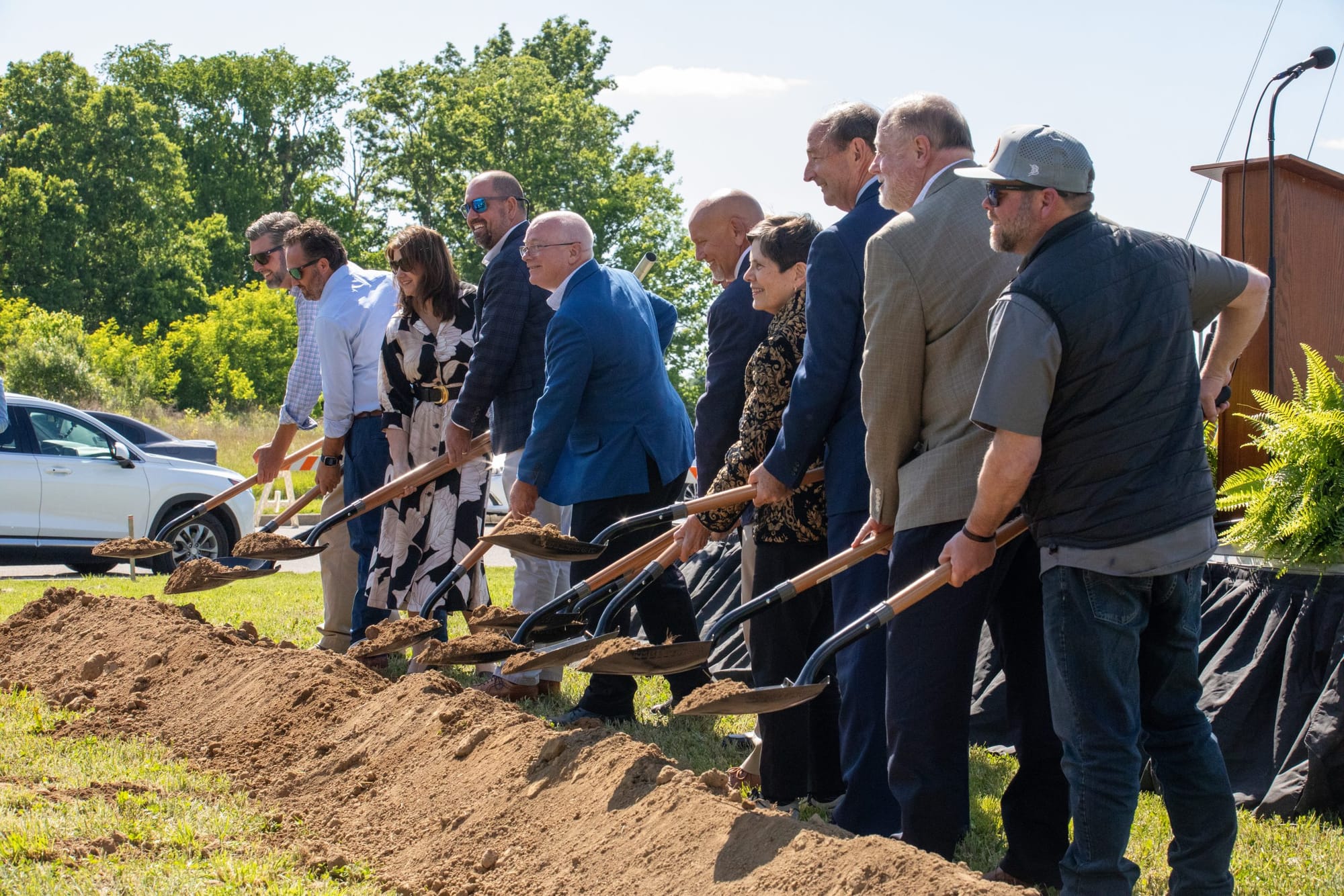
Instead, the Berea Industrial Authority sold the 300 acre parcel of land to the CKBPA for $500,000, which was paid in equal shares by the other three partners, and at last the first park was underway. It had its groundbreaking this past May.
Compared to the County, there has been little to no controversy around the regional agreement in Berea, perhaps because the site is in an established industrial park, according to Fraley. As with the County's announcement, The Edge had yet to begin publishing, and so did not cover discussions about the agreement. The City of Berea also posted notices on October 1 and October 21 of 2024, about the interlocal agreement, but there was no specially called public referendum.
"There should have been a clearly communicated plan for what was going to happen with this deal so the public could have had a say. There should have been a public referendum," Ricky Clontz, who is challenging incumbent Bruce Fraley in this year's nonpartisan mayoral election in Berea, told The Edge in an interview.
"Plans for the regional business park in Berea have been regularly and openly discussed in Berea City Council Meetings and work sessions, and we have received positive feedback it since it was proposed in late 2024," Fraley said in an email.
Highway hubs
Regionalism is trendy in economic development circles nationally. A paper published in 2025 by SSTI, a pro-industry think tank, backed by Trump's US Dept. of Commerce, claims regionalism helps regions reach advanced levels of technical capabilities simultaneously; encourages collaboration along the supply chain, and if there is an academic institution in the mix, fosters research hubs.
Another classic hallmark of regionalism is it features a major highway. Yet another is that there is already a manufacturing presence. Berea in particular, with its two exits off of I-75 and its well established industrial park that is home to Hyster-Yale and the Honda-owned Astemo, helps the CKBPA fit the bill.
“I believe with all my heart and soul, and my mind, that regionalism is the way of the future,” Fraley told The Edge in a sit-down interview early last year.
Gov. Andy Beshear (D) also has embraced the concept of regionalism, having redesigned the state's $35 million in product development initiative funds to prioritize projects that emphasize collaboration between jurisdictions. The goal, according to Fraley, is to be competitively on par with regional highway hubs such as Columbus, Ohio or Charlotte, NC.
More than $4 million of the $5 million needed for site preparation and infrastructure extension at the CKBPA's Berea location has come from the state, with another $141,000 from the state to pay for due diligence studies on the property. Earlier this year, Congressman Andy Barr (R) announced he had secured $2 million in federal funds to shower on this "major economic development project."
"Without regional collaboration, we would not have received this $6.1 million in total funding for the Berea site," Fraley told The Edge in an email.
Similarly, this year, with the help of one of Frankfort's priciest lobbyists, Stephen Huffman, along with State Sen. Jared Carpenter (R), the General Assembly approved giving the CKBPA $20 million to purchase the Carr farm.
Profit and resource sharing
The costs and profits related to each business park are to be shared equally between the interlocal agreement partners. Additionally, the host jurisdiction of each business park is to take an additional 10% of the respective park's total earnings to help pay for infrastructure maintenance in and around the site.
State Rep. Deanna Gordon (R, 81st) sponsored a bill last year that the General Assembly passed, allowing regional industrial authorities to set their own taxing structures. Fraley told The Edge that for the CKBPA, the occupational license fee of the governmental entity hosting the business park applies to all business located there. The occupational license fee for businesses in Berea is 2%. In the County it is 1%.
As for labor, there is a precedent in Central Kentucky for regionalism, even without an interlocal agreement. Currently there are about 3,500 workers employed in the Berea Industrial Park, according to Berea Business Development Director Donna Angel, who told The Edge in an interview that half of those come primarily from Scott County. The CKBPA claims the Triple Crown Business Park will attract between 700 to 1,200 additional jobs once fully built out over the next decade.
'Land grab'
Some area land developers don't like the CKBPA. Several credible Madison County Republican Party insiders told The Edge that both Taylor and Fraley lost the backing of at least one of their staunchest supporters, a wealthy Republican land owner with multiple holdings across the County, as a result of the agreement being perceived as a Lexington land grab. Other land speculators were angry about it, too, according to the sources, who did not specify why.
Thanks in part to a combination of a steadily growing population and a decades-old agricultural conservation easement program that seeks to preserve 50,000 acres of farmland, primarily large horse farms, Lexington has very little acreage it can develop for industrial use.
Mayor Linda Gorton's office says the accusation that she is leveraging other jurisdictions' land strictly to benefit Lexingtonians is not true.
"The Lexington Fayette Urban County Government entered into the partnership with Berea and Scott and Madison Counties in order to share resources for the good of the entire region," Susan Straub, Lexington Mayor Linda Gorton's director of communications, told The Edge in an email. "Lexington was actually the last community to officially approve and adopt the formation," she said.
Straub also contends none of this was Gorton's idea, but was the brain child of Taylor and Covington. "Initial discussions involved a site in Georgetown," Straub said. "There was the possibility of getting funding from the Kentucky Product Development Initiative that made it attractive."
Straub also stressed that Gorton was not in on preliminary talks to acquire the Carr farm, either. "[It] was initially part of an option the Madison County Fiscal Court agreed to. The option was then presented to the CKBPA board to see if they would have interest in taking over the option to the property which the board agreed to do," Straub wrote in the email.
Fraley meanwhile told The Edge the idea of a multi-jurisdiction regional business park preceded the formation of the CKBPA, when he, Taylor, and Richmond City's Mayor Robert Blythe, "explored ideas about how to collaborate more on economic development."
Low bar for zone changes
For the Carr farm sale to happen, the Madison County Planning Commission has to recommend—and the Fiscal Court must adopt—a zoning change on the land. Currently, the land is zoned for agriculture. For the appraisal to be valid, it must be zoned for industry.
Zoning changes have proven a low bar for developers to clear when they come before Taylor's Fiscal Court. Taylor is himself a builder who always has been candid about his pro-growth agenda. Multiple developers in the last few years especially, have received little to no pushback from the administration, often despite stiff public opposition.
"I can't remember a single zone change request that has been turned down by this administration," Madison County Magistrate Billy Ray Hughes (Dist. 3) told The Edge in an interview. Hughes took office in 2022. He recently won re-election in the May primary.
"Everything gets approved," Hughes said. "The lawyers do a lot of the legwork because they are working for investors. They know not to bring something that isn't locked down. But when the sign goes up on the property to alert the public of the requested zone change, then the cards are stacked against the grassroots organizers who are just trying to protect their communities."
In 2024, Hughes was the sole dissenter in the Fiscal Court's approval of builder Jack VanWinkle's request for a zone change in order to build a subdivision in Union City, adjacent to the fairgrounds. It was VanWinkle's second go-round on the Moberly Road property. In 2015, Taylor approved it, but the then-magistrates, which included current magistrate Tom Botkin (Dist. 4) all split with him and denied VanWinkle's request.
Also in 2024, when a distillery on Jacks Creek Road in the North of Madison County, planned by Versailles-based developer Guinness McFadden, was given a conditional use permit by the Board of Adjustments—a binding decision not subject to approval from the Fiscal Court—a cohort of angry area residents formed a nonprofit watchdog group.
Preserve Madison County, as it is called, has taken a stand on every development decision in the County, including the potential threat from hyper scale data centers, since its formation. Among their goals is to highlight lack of transparency in planning and zoning decisions.
"Investment from the state [for the Carr farm project] was secured before this project ever went in front of the Planning and Zoning board for a zone change. It seems as though our own elected officials believe community input at the planning and zoning level will just be a check box, and approval is easy enough to get," Westerfield, a founding member of the group, told The Edge in an email.
Taylor routinely characterized Preserve Madison County as the vocal minority until he was thumped at the polls during the May election when he lost by a 20% margin to newcomer Donna Agee. The vote was 4,566 to 3,686. A third candidate for judge executive, Chuck Givens took 1,470 votes. Agee declined to comment for this investigation.
Now, Preserve Madison County is worried Taylor is jamming through developments before his term is up in December. For tonight's meeting, there are eight zoning change requests on the Planning Commission's agenda.
"I've never seen so many on one agenda," Hughes told The Edge.
The Carr property is listed as the fifth agenda item (see document below). A findings of facts (see below) released ahead of the meeting indicates the Commission plans to recommend the zone change to the Fiscal Court. Tonight's Planning meeting is the last regularly scheduled one before the CKBPA's option to purchase the Carr property runs out on August 26.
Signature economic project
The Planning Commission's findings of fact for the Carr property claims zone change will "support the retention, expansion, attraction and diversification of business entities to support [the] local economy." Further, that it will "increase the County's capacity to support economic development initiatives," which might include those in the "hospitality and tourism industry."
For some time, Taylor has been searching for his signature economic project, especially since the end of the chemical weapons decommission project at the Blue Grass Army Depot left gaps in the County's revenues and employment numbers. The Carr property project, according to Taylor, will help fill those gaps.
His narrative has been that more jobs in the County mean less commuting to Lexington, "If we have the jobs, people will think about staying here," Taylor told The Edge in an interview last year. A key tenant of the argument in favor of the CKPBA, meanwhile, has been that it will broaden opportunities across the region for workers who will choose to commute across county lines to the various participating business parks.
The findings of fact in the Planning Commission's recommendation also claim that Lexington Road has "significant capacity to handle whatever traffic is generated" by the business park. Currently, however, there is a precipitous berm supporting a narrow stretch of Lexington Road at its intersection with the Carr farm entrance.
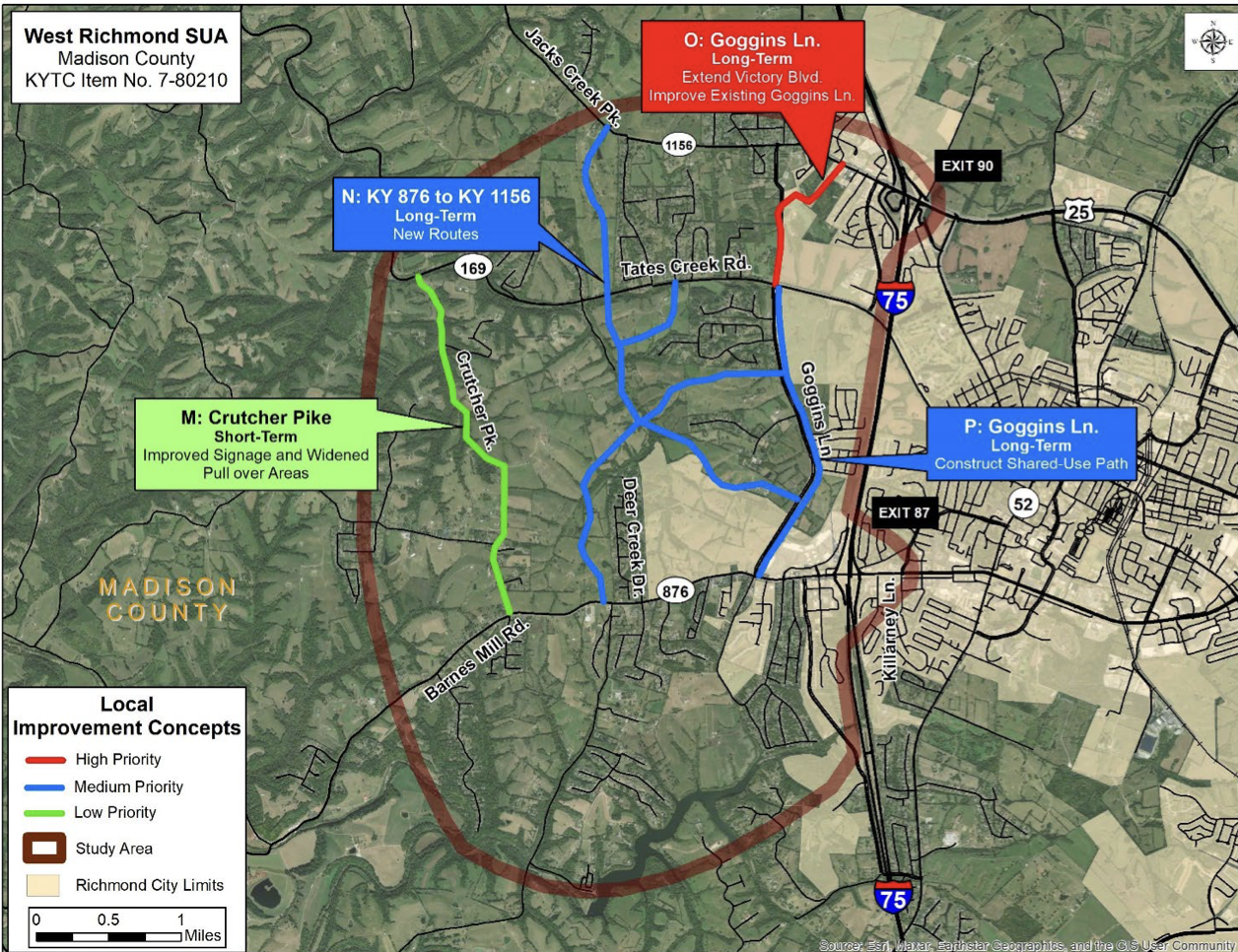
But there is this: a study conducted by the state's transportation cabinet seems to have taken the traffic capacity of that section of Lexington Road into consideration, although it was published months before the Fiscal Court put an option on the Carr farm.
Released in April 2024, the West Richmond Small Urban Area Study by the Kentucky Transportation Cabinet analyzed traffic patterns from Exit 87 off of I-75 headed west along Barnes Mill Road including where it intersects Goggins Lane, plus the more traveled arterial roads north of there to Hwy 25 in the east. Based on the recommendations of the study, this year the Fiscal Court was awarded nearly $10 million by the state to build a connector road, tentatively named Victory Lane (it has been reported as both elsewhere), between Goggins Lane and Hwy 25.
The Edge challenged Taylor on the efficacy of the study during a podcast interview last May, on the grounds that it seemed a poor solution for traffic remediation when improvements for the actual highway exit three miles to the south of the proposed connector road was only allocated $1.5 million by the General Assembly. However, the addition of the connector road would help alleviate construction and other traffic at the Carr farm site, although improvements would still be necessary at the intersection with Hwy 25.
Political class
While The Edge found no evidence of corruption per se, the fingerprints of a political class appear to be on the state's decision to award the County with cash to build the connector road, among other aspects of the Carr farm deal. Two credible sources told The Edge that lobbyist Huffman, along with Carpenter, were also involved in the state's decision to fund the connector road.
In the podcast, The Edge asked how the new connector road might help Taylor personally, as he co-owns a parcel of land at 2209 Lexington Road that he and his two business partners have struggled to have rezoned in the City of Richmond as multi-family residential. Taylor did not answer the question directly.
One of Taylor's business partners in Trifecta Blue, LLC, the company that owns the parcel of land at 2209 Lexington Road, which Taylor says would not have road frontage on Victory Blvd, is Jaron P. Blanford, managing member of the influential law firm and lobbyist group in Lexington, McBrayer/MML&K.
MacBrayer is the same firm that has been managing the legal dealings of the CKBPA. It is also the firm contracted by Madison County to handle alcohol licensing. Blanford is not the lawyer involved in the CKBPA, Anne-Tyler Morgan is, along with Neal Morris. Preston Worley, former Democratic state senator Ed Worley's son and another lawyer at McBrayer, is representing the Carr family in the sale of the farm to the County.
The coincidences, however tangential, continue with the Fiscal Court's recent purchase of 107 Carr Lane to build a fire station that will serve the northern portion of the County, including the Carr farm property. The County bought the land from Jack Marcum, whose development company is listed with the state as Victory Lane Development. A fire station's proximity is cited in the findings of fact as an argument in favor of the zone change, although which of the three area stations, including White Hall Volunteer Fire Department, are not specified.
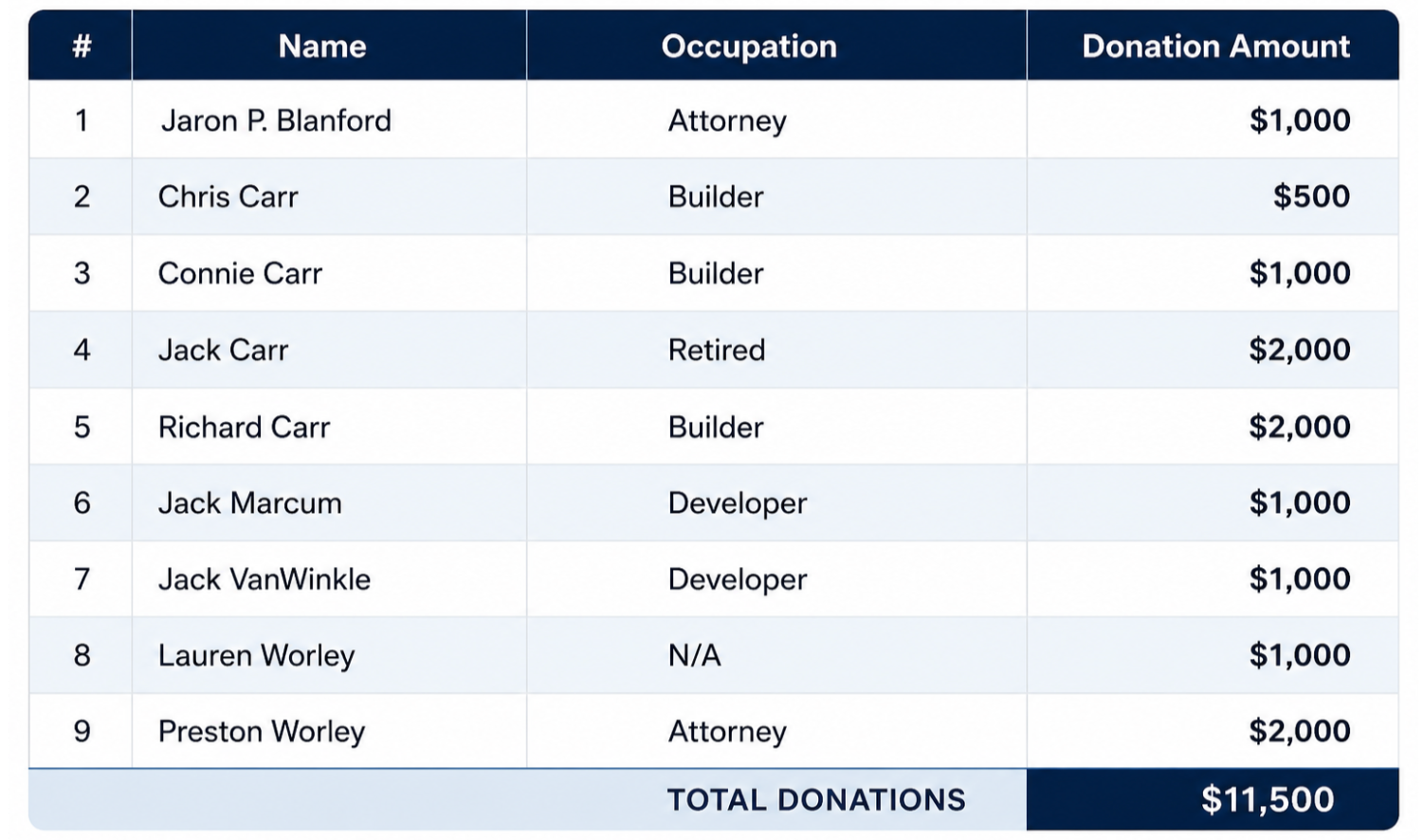
With the exception of the lobbyist, Huffman, and the distiller, McFadden, all parties to the Carr farm zone change or other developments, made about 10% of all contributions in the aggregate to Taylor's election bid that ended in May. The combined total of donations was $11,500. In all, Taylor raised just over $100,000. The maximum allowable gift from an individual in the state is $3,500, according to the state's registry of election finance.
Geology and archaeology costs
Once zoning is out of the way and the purchase of the Carr farm is made, there are yet other hurdles. A geotechnical analysis conducted by an engineering firm hired by the Fiscal Court, found there is the documented presence in and around the property of a geologic feature known as karst, a network of caverns, underground springs, and unstable ground prone to sink holes. Additionally, much of the land has what the report classified as "plastic soils," primarily clay and other soft soils.
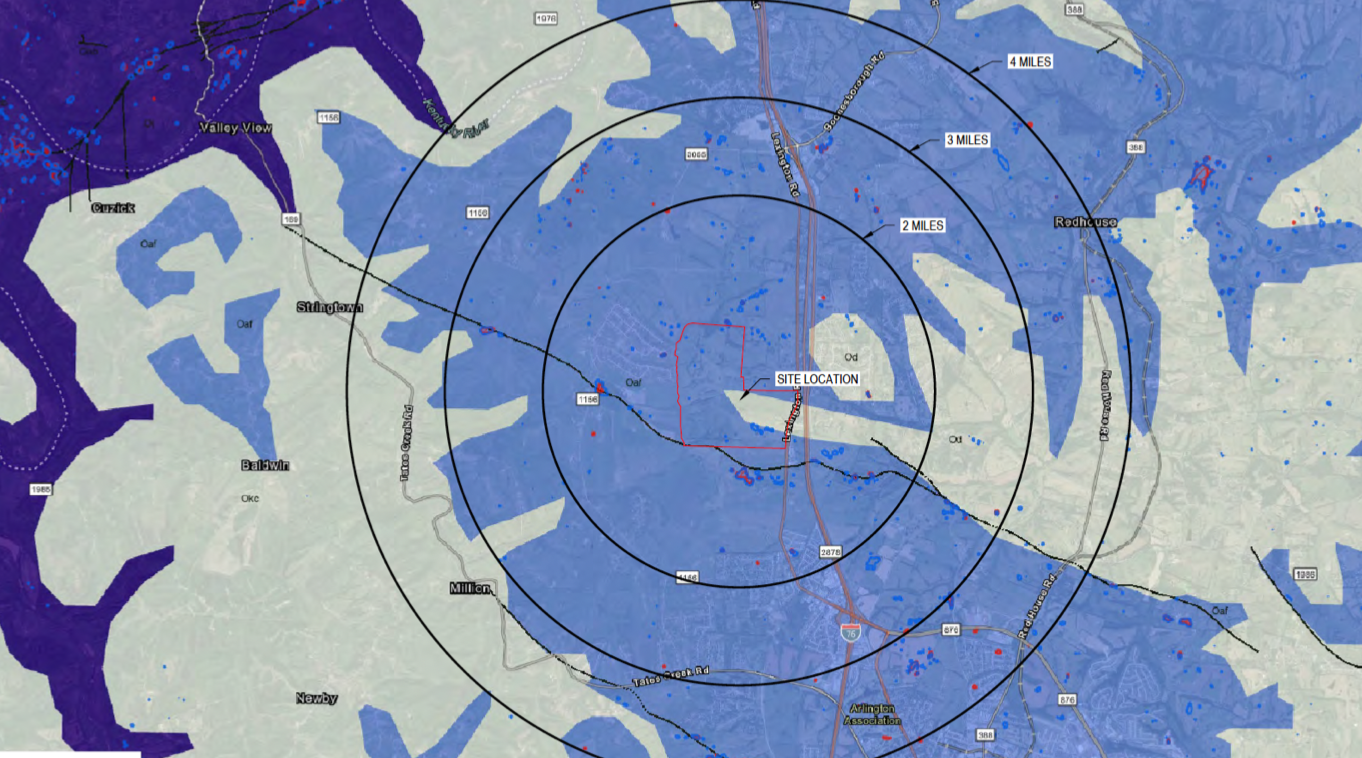

According to an engineer involved in the geotechnical study who spoke to The Edge on background only, such geology is "completely normal" for the region, which is why the report also details multiple industry-standard remediations recommended by the engineering firm. There are, however, multiple warnings throughout the document that the level of moisture in the soil at certain points on the farm, and a high water table in at least one area of the property, could require additional remediation.
The estimated costs of excavating and grading the property are about $55 million (see graphic below). How this will be funded has not been disclosed publicly. The final estimated total to prepare the property for use as a business park is $63 million, with an additional $4.9 million for paving.
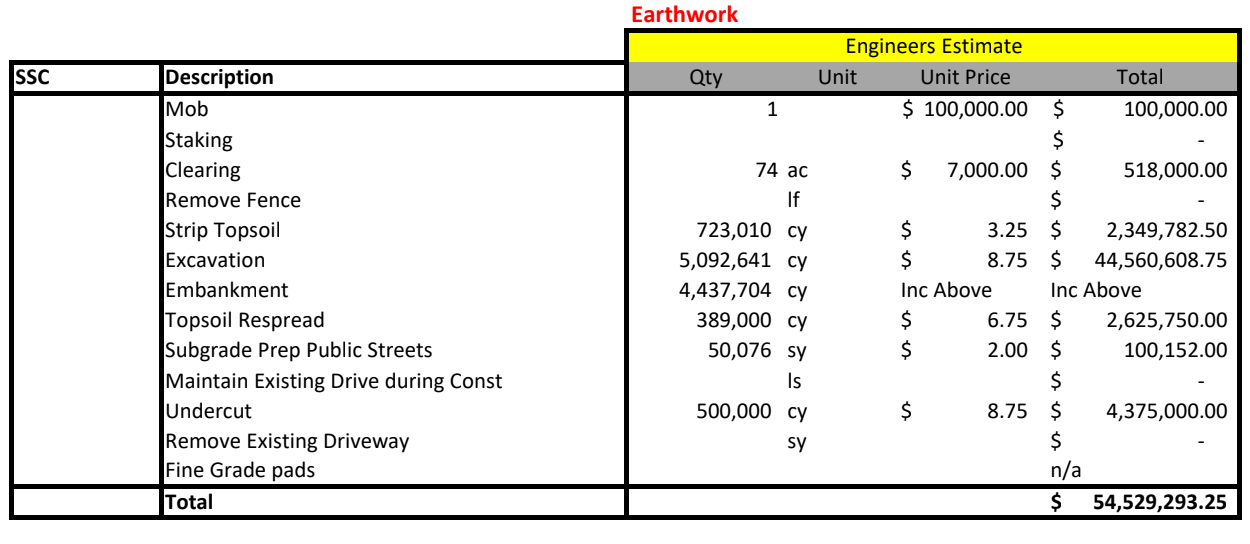
In addition to a geo-technical survey, an archaeological review also was conducted on the property last year. Also speaking on background only, the archaeologist who conducted the study on behalf of the County told The Edge that although his recommendation is that an additional archaeological study be conducted, he was not bullish on the odds that anything significant would be discovered.
Still, because the project is receiving state and federal funds, the additional archaeological review, yet another cost, is mandatory, according to a state official.
“If federal monies or permits are, or will be used, for any aspect of a project, then the project is an undertaking under the National Historic Preservation Act. Under the National Historic Preservation Act, the The Kentucky Heritage Council) must be afforded the opportunity to comment," Kentucky's Site Protection Program Administrator, Nicole Konkol, told The Edge in an email.
Should the deal go through and a business park be built on the Carr farm, one thing is certain. Whoever is contracted to do the paving, earthworks, and other site preparation will certainly profit, regardless of whether the park itself ever turns a profit.
The Madison County Planning Commission meets tonight at 5:30 in the Fiscal Court Room at 135 Irvine Street in Richmond.
Sign up for The Edge, our free email newsletter.
Get the latest stories right in your inbox.