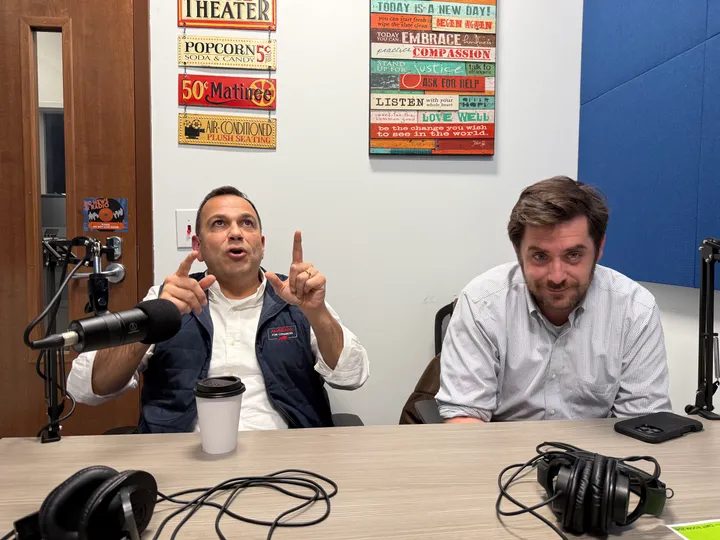
On the Edge with David Kloiber (D), Congressional candidate for Ky 6th
What innovations would this physicist, business man, and software developer bring to Washington?

Join me as I speak with Kentucky's 6 Congressional District candidate, David Kloiber, a Lexington "New Democrat", physicist, and software entrepreneur who previously served as a Councilman in Lexington.
Listen as Kloiber describes his innovative ideas for how to immediately reform our healthcare system, bring about housing affordability, and considers whether our current slate of Congressional members are too old to understand how AI has and will continue to change our world. Also, do we need to start discussing a universal income as AI increasingly puts people out of work?
Transcript after the subscription button.
And if you have questions or comments, feel free to drop me, Whitney McKnight, a line:
Sign up for The Edge, our free email newsletter.
Get the latest stories right in your inbox.
Speaker 3: 00:00
David Kloiber, welcome to On the Edge with me, Whitney McKnight, host and producer. You're running for the 6th Congressional District of Kentucky. Welcome.
Speaker: 00:08
I know it's a mouthful, but yes, we're running for Congress in Central Kentucky.
Speaker 3: 00:12
Do you have any kind of legislative experience? Have you ever run for office before? Is this the first time?
Speaker: 00:17
Yes, I actually served on the city council in Lexington. So LFUCG. I was the sixth district city councilman there, so fortuitous if we're looking that way about what we're running for now. But yeah, I served there during uh the pandemic, actually. So it was an interesting time to be in that kind of a legislative experience. It is a nonpartisan race, but people don't necessarily leave those partisanships at the door. So a lot of uh bipartisan stuff that we had to get together and make sure we could try and rebuild the city after that pandemic.
Speaker 3: 00:47
So did it make you feel like you could accomplish things in a sort of legislative or um governing body situation? Did it kind of fire you up to do this even bigger scale?
Speaker: 00:58
Yeah, I mean, as as soon as you get into a position like that where you're you're talking about really making kind of legislation for people that's gonna affect them in their daily life, you gotta learn the process, you have to learn how everything works, and you're really drinking from a fire hose when you start out. But uh, after you settle in, you start to see the real impacts, you're talking to people in the community, you're seeing how the things you're getting through and passing are affecting them and making things better. So, you know, for anybody who's done it, then they know that they get the bug and they just want to continue to get out there and try and make that impact.
Speaker 3: 01:31
So your three main plat uh the three points of your platform all dovetail into the uh the affordability crisis.
Speaker: 01:39
Yeah, that's that's the word where we're all hearing a lot is affordability. Um we're all feeling that pinch. And so I've put together a platform that specifically tries to address that, you know, where people are and it tries to affect them, you know, in their pocketbook, making sure we've got more money in our pockets, things are cheaper, more affordable, and we've got a place to live and uh raise our families. So that's that's what's most important when you're trying to raise a family in a community like this, is that you got money in the bank, that you can afford to take people to the doctor, and that you can have a roof over your house. And I think after you get there, you can start talking about bells and whistles down the line, but you got to start with those fundamentals.
Speaker 3: 02:16
Well, let's break them into thirds here. So let's start with healthcare. Uh, you have an interesting plan that really kind of addresses all of the middle people, getting the middleman out of healthcare. Um I mean, I will say, I will say, as a former career healthcare reporter and healthcare policy reporter, uh, the system is designed to do exactly what it's doing. Yeah, it's designed to make money.
Speaker: 02:42
So we don't have to change the whole system in order to start making these steps forward. I I often tell people, you know, if you're gonna cross a river, don't do it where the current's strongest. And that's kind of how this policy came about. It was where can we get everybody on side and then see a real result that's going to affect people at home? So the policy itself is pretty straightforward. It deals with the money we already give for research, but don't get a direct monetary benefit. That we look, we look at that and we say, all right, to these companies they're gonna be benefiting from public dollars, we deserve to get that benefit. So let's negotiate our prices at that point when we have leverage, allow them to cut through some of these middlemen, and then pass those savings directly on to us.
Speaker 3: 03:28
I want to fill in the background there. You're absolutely right that we spend not just millions, we spend billions of dollars. The National Health Institutes of Health, the NIH, that is the largest medical research budget on the planet, always has been. And I think it's really interesting that you've tuned in on that and that you've made that part of your campaign because I don't hear a lot of people talking about how much public money in the number of billions. I think 10 years ago, when I was a reporter and I covered that a lot of the things happening at the NIH, their brain project, so it was just the National Institute of Mental Health, they spent almost five billion dollars alone, one institute. So what happens when drug studies are funded by the NIH? Millions, maybe billions, usually it's more like hundreds, tens of millions, I'd say, thinking about a budget for um a cancer drug. That's public money, but then the patent goes to the drug company and they make the money.
Speaker: 04:26
Yeah, that's right. And and really what we've been sold is this idea that we're gonna get an economic benefit, you know, that every dollar that goes in generates four and a half dollars, I think is the term they've used. But where is that money actually going? Because it's not coming trickling down to everybody down the ways. We're seeing it kind of being hoarded in certain areas with record profits in some of these companies. So when we see that the end product of all the research, and by the way, it's great research, we have to keep doing this research. When we see that the end product is something that's three to four times higher than the average of all the other countries in the world, you know, we know something's wrong. And we know we shouldn't be footing that bill and not getting the benefit back.
Speaker 3: 05:12
So what would that look like? How how would it actually be in practice?
Speaker: 05:15
The best part about this is we're talking about grants. And grants are very structured, right? I've given a lot of grants through my nonprofits, I've worked with people to get them. You can put a lot of writers on a grant. You can say, this these dollars come here, this is the performance that you're expected, this is the requirement to receive this grant. So when the NIH has given out these, like I said, $200 billion over the last 10 years. It might be more now, but I'm just saying that's the last study. You have an opportunity to say, here's the structure to receive these funds. Any institute that gets these funds, and anybody who wants to, you know, prove out in through an FDA approval process to get their drugs certified, they're gonna take this money and they're gonna say, All right, our catalog is now negotiated at this price at that point. So we essentially say, instead of relying upon the executive branch to come in at the end of the end of the time and say, we're the biggest uh the we we buy from you the most, we're your biggest customer, let's negotiate on these seven or eight different drugs. We can say we're giving you the money to continue doing what you're doing. All your future profits are based around this continuing cycle of research. We all need this research, so let's attach this whole structure to it and say, now when you get these dollars, we're agreeing that the price you're going to sell to us is here. And it's just like it is across the world that these other countries.
Speaker 3: 06:39
Aaron Powell Well, it's true. Other countries do not pay anywhere near as much as Americans pay. But how are you going to legislate that? Because pharma, that's a big industry, and they have a lot of lobbyists invested in Washington. So how do you legislate against that severe wall of resistance that I'm imagining you would get?
Speaker: 06:58
Aaron Powell The best part about this is that because we're talking about cutting out these middlemen, and we can talk about pharmaceutical benefits managers and what we will. Yeah, we will.
Speaker 3: 07:08
Okay, good.
Speaker: 07:09
But in this process, what we're doing is we're allowing them to bypass this middleman. So we're not asking them to take a pay cut on their actual profits. Okay.
Speaker 3: 07:19
I think we're going to need to unpack that. Let's talk about the middlemen because I think for the average listener of this podcast, they're not going to be into the weeds about the PBMs. Okay, so I'll just say kind of at a 30,000-foot level. PBMs, they're pharmacy benefit managers. Really, I remember it was about 20 years ago. Places like CVS, which is a drugstore. I don't think we have one here in this region, but it's it's a probably the largest drugstore, right aid, Walgreens, but CBS is bigger. Um, they started a business called pharmacy benefit management. And it's basically the middleman that negotiates on your behalf the prices of the drugs that will be covered in your healthcare plan provided to you by your employer. And then it's extremely opaque. You have no idea how this negotiation has happened, but there's a lot of kickbacks. We don't really know how they're making their money. And a lot of times it's very punitive to the person who's actually supposed to get the benefit because the negotiation was done without any of your input.
Speaker: 08:19
Not only that, but these groups are kind of like distributorships. They kind of take each of the different pharmacies and they they set out, you know, this is my turf.
Speaker 3: 08:27
Yeah, well, CBS uh owns everything. They own the manufacturing of a lot of the generic drugs. Not all drugs, but like I think they they manufacture some uh well they do. They have like the ibuprofens and the generic, all the generic um pain medications that are over the counter. They have the minute clinics, so they're basically collecting on the care that is delivered. They also have the insurance Aetna they now own. And they have the pharmacy benefit. They also do a lot of other manufacturing of things like syringes and that kind of stuff. So really this is a this is an antitrust problem. So are you looking at delivering care and hitting on antitrust at the same time?
Speaker: 09:10
Yeah, so that's that's really where this comes in. Because again, as you pointed out, I think something like 53% of all the legislators that we have are receiving some kind of benefit from pharmaceutical companies and healthcare companies. It's one of the biggest lobbying groups in the country. And if you go straight at them and say, we're trying to cut down your profits, you're gonna have a hard battle on the hill. So the idea, again, we don't want to cross where the current is strongest. We're gonna say, look, we're gonna put a structure in here directly talking to the pharmaceutical companies. They're as frustrated as the rest of us when their prices get unduly inflated and they don't see those profits, right? Which is what's happening in a lot of these PBMs. And as you pointed out, they've got an end-to-end monopoly. They're they're sitting there, they're giving themselves rebates on one end, they're taking those fees on the other. And who's the bad guy, right? Now, I'm not saying that a corporation that's making, you know, record, record profits at the same time that people are experiencing such horrible outcomes with their health care is completely blameless. But what we can do is say, let's help them cut through that middleman. We're gonna be able to take those savings and those prices and cut through on the bureaucracy. The pharmaceutical companies are gonna get on board because they don't want to deal with these PBMs any more than the rest of us do. They just happen to do it every single day, so they have a more of a vested interest. So I actually expect that we'll be able to get their support on this kind of a bill as opposed to having to fight them.
Speaker 3: 10:43
That's really creative. Um yeah, because it's a it's a force of nature. I mean, it really is the pharmaceutical industry, but it's kind of a complex. It's the pharmaceutical insurance complex. So I do think this is creative because you're getting around the usual ways that they partner up.
Speaker: 10:59
Trevor Burrus, Jr.: Well, we're not we're not gonna see actual results if we keep doing the same thing we've been doing. I mean, I know personally, I'd like to see us get to a system where everyone had healthcare coverage that it wasn't tied to employment. But I'm not gonna go to the constituents of this state and say, I can go in day one and make that happen. Right? But what I can say is if we can lower these costs, a public option comes back on the table. Because we all remember during the ACA debate when Obamacare was first getting pushed through, the public option got pulled out because people had so many concerns about those costs. Well, every step we take that reduces those costs not only makes it so that you're paying less at home, but we're putting more options on the table. We can move more towards a public option when we know what those prices are going to be. We can say it's a fixed cost going forward. And as soon as we get there, it's just a hop, skip, and a jump to uh a more universal healthcare.
Speaker 3: 11:55
Well, it is creative. And what I'm wondering is, let's say you're elected, you go to Washington, who are gonna be your allies? Do you have you already kind of thought ahead to these are the people who would get on board with this and making this more likely quicker?
Speaker: 12:09
Yeah, I mean, obviously the biggest caucus is the new Dems that are gonna be interested in working bipartisan because again, I'm I'm looking very realistically, even I'll say when we flip the house, um, we're gonna have a split Congress, right? We're not gonna have complete control over the House and the Senate and the executive branch at the same time, at least not for a few more years. That's in something we want to work towards, but it's not what we're gonna have. So we need to work with people like the new Dems, people like the Blue Dogs, who are a small group but are gonna they have about 10 people who who can try and help influence votes one way or another. The new Dems who have a lot more people who can try and help work across party lines, and we caucus together to make sure that we can actually get things both in the Senate and the House.
Speaker 3: 12:55
I think for the sake of my audience, it might be a good idea to talk about who the new dems are and who the blue dogs are.
Speaker: 13:02
Yeah, so um right now one of the the largest uh caucuses in the house are the new dems. And these are a group of people who are committed in principle to getting things done. They they say we'll work with anyone so long as we're working for people, right?
Speaker 3: 13:17
It's really that that's isn't that their job anyway? You know, you'd think so.
Speaker: 13:20
You'd think you wouldn't have to put that down at the top line, but but they have. And what we've seen from them is they've gotten stalled out in a lot of these negotiations because people have been taking these very strong ideological lines, and we've gotten entrenched in the same battles we've always been in. And so my ideas and principles are to give them a little bit of new new life, to give them a few new avenues to try and get that bipartisan support. And so each of my principles directly relates to how it's going to help the constituents, regardless of their party. And so, you know, giving those tools to the new Dems is going to be really just, you know, a big uh a big driver that's gonna help them get things across the line.
Speaker 3: 14:07
And talk to us about the blue dogs.
Speaker: 14:09
So the blue dogs, obviously, um, much smaller these days, but they have been a primarily fiscally um conservative group that is very liberal. So they have never put out a social policy, but they've basically said to Democrats, if we want to talk across the aisle and we want to get things done, we need to make sure that the dollars make sense. So they're a fiscally conservative group that has uh has waned in popularity over time as people have focused more on social issues, but there's still about 10 of them, I think, in uh in Congress, and they can help swing when we're gonna be in these close voting situations.
Speaker 3: 14:40
Well, surely Chuck Schumer is not one of them.
Speaker: 14:42
No, not last I checked.
Speaker 3: 14:43
So who I'm trying to think? I actually not one of them is coming to mind. I can't think of a single fiscally conservative Democrat.
Speaker: 14:50
Mm-hmm. Yeah. Like I said, it's a small group. There's there's about 10 of them right now. And none of the the big players, right? They're not they're more of a voting block that could help push things one way or another. But uh like I said, the new dems are one of the biggest uh the forces out there that I'd probably be caucusing with to try and get things done.
Speaker 3: 15:08
Well, the interesting thing is that you you did, or the new democrats have to kind of reiterate what the job of Congress is. One thing that I'm I'm wondering about is beyond the new Dems, the the temperature in Washington has just kind of gone to full-blown hot. You know, the the barometer, the the Mercury's probably spilling out of the glass. But things will change because let's say you're elected, you'll have a two-year term, and that will coincide with the end of the current president's term. So whatever happens after that, it it just because of the way things are now, I'm imagining that will be a very dramatic shift, whatever happens. Um so you've really got a window of two years that things will be stable, air quotes, you know. What can you achieve in two years?
Speaker: 15:59
So this is where actually having been in a legislative body helps a lot because you know where to put your efforts first. And so really it's getting into committee, right? We know that the process to get something through committee and out to the floor, it it's a process. If we're putting things in early on in this, this uh this term, we're only going to start seeing those things coming out, potentially for votes if we're really working together by the end of those two years, right? Be right before the next election cycle. And so really focusing on which committees are going to be the best benefit for these policies, making sure that we get that bipartisan uh sponsorship, we get those support, and we're able to push it through committee is going to be the strongest indicator that before these two years are up, we could actually have a vote and get something implemented.
Speaker 3: 16:47
So it sounds like there is um there is actual groundwork being laid ahead of the election.
Speaker 1: 16:52
Okay.
Speaker 3: 16:52
All right. Well, before we talk about the two other uh pillars of your affordability platform, you mentioned something that I wanted to explore a little bit. You said when you've run nonprofits, you will structure grants certain ways. So maybe it's important to talk about what your career background is so that people know what kinds of experiences you're bringing to the floor.
Speaker: 17:12
Yeah, I mean, um, so I grew up in Fayette County. I went to Lexing Catholic High School and then went to UK. And I studied physics and mathematics there for a few years and left in my final year to go start a software company with one of my friends. We were doing uh natural language processing. So that was that's kind of the baby steps to the LLMs or the AI.
Speaker 3: 17:32
So you're one of the first steps to AI. Yeah.
Speaker: 17:35
So um so we were doing that back in 2004, 2005. And um, you know, after we went our our separate ways, my father sold his software company that he'd been building for 30 years. And that was one of the single largest sales of a software company in Kentucky at the time. And he asked me to come in and help him manage assets so he could retire and and go out into the world and get some relaxation. So um I started an investment management company. I did that building up companies, investing in companies around the country. And then uh I I simultaneously agreed to do that for my father if he let me start a nonprofit right back home in Lexington, Kentucky. So I started the Kloiber Foundation and we've been focused on uh education and technology and student outcomes for the last almost 15 years now.
Speaker 3: 18:25
So STEM, essentially, STEM for primary education?
Speaker: 18:29
Yes, primary education. We um we've we've done a little bit of work in you know um early development, um a lot in K through 12. Uh every once in a while a project just works out and you you get involved in it and you really can throw your heart into it. And so we've just done a lot of those, but primarily we're trying to focus on making sure that that kids are ready and have the tools and are prepared before they go out into the world.
Speaker 3: 18:53
Um This is kind of an ancillary question, but I'm curious because i it will inform the way you think about handing out money. So do you does your foundation receive federal dollars?
Speaker: 19:06
They do not.
Speaker 3: 19:07
Okay. So this is simply charitable, not government grants. Yeah, but it still probably does color the way that you think about investing money for an outcome.
Speaker: 19:16
Yeah, and look, we can go into spreadsheets about social discount rates and and how we get the most leverage and make sure that we're impacting a community. But at the end of the day, we try and find projects that are going to leave the community better than when we found them and that they can build on themselves. So a good example is a program we uh started at the Lexington Public Library. We we helped them build a uh Steam Lab in their central library and it has 3D printers and it has drones and all sorts of other tools. But one of the requirements was that they had to hire on a full-time staff to put programs in there. And so now we have kids coming through, programs that are sustaining themselves, and they've had such a good influx there, they've expanded the program to more of the libraries throughout town. And so that's the kind of seed that we planted and we said, you know, if we're gonna come this far, you're gonna meet us, and now we're just growing and growing in order to have a bigger impact.
Speaker 3: 20:13
I think that's an interesting combination. And the reason why I wanted to kind of talk about it a little bit is because I wonder about some businessmen who are running for for Congress. Um, all of the businessmen strike me as go-getters, get it done. Because that's how you have to be if you're an entrepreneur. But that is not how Washington works ever. I mean, and that is one charm for a lot of these people who support Trump. That's one of the things they love about him, is he just cuts through all of the traditions, etc., maybe sometimes other things too. But Washington is not a fast place. So how do you address that? You know, as but it sounds like you've got a step in both, you've got feet in both worlds where it's I understand the business and the entrepreneurial section of the industry of the marketplace, but then again, I also understand that things take time. Because I think that's a challenge for a lot of people who come to Washington expecting things to be the way it is in their real world.
Speaker: 21:10
I I mean, I would be lying if I said it wasn't a challenge when I first stepped foot in office in Lexington. Because again, I wanted to get things done. I came in, I said, listen, we're gonna address the budget, we're gonna address you know what we're doing, and now we're in a pandemic, and oh my goodness, how do we how do we get this done, get this going? So um, but you know, it's it's that experience of of going through the process of getting something done that you you realize there is a purpose, right? We're not doing things slowly just to be slow about it. They're moving, some people say, at the speed of government, but you're moving at a speed that's going to be responsive to the people you're trying to represent.
Speaker 3: 21:50
Aaron Powell And that's true. I mean that that's actually the reason it is slow, is so that I mean, because it'll last forever. It's really hard to undo a government something once the something
Speaker: 22:01
Trevor Burrus, Jr.: And we're we're seeing a lot of that um in the current state legislature where the incentives are more to just pass laws than they are to revisit old ones. I know that a lot of uh a lot of legislators I've talked to are are really interested in getting that uh that bill on the wall, that framed bill, because they got one passed. That's kind of a tradition that they have up there on the Trevor Burrus.
Speaker 3: 22:21
But that sounds very self- self-serving.
Speaker: 22:23
Well, that's again, that's what I'm saying. And when you make that the incentive, you're not addressing these issues. Now, I will tell you, I I served on counsel um with who is now a Republican state senator, Amanda Mays Bledsoe. And she was tasked with doing something at the state to say, what are we gonna do about AI regulation? And I will say that when I sat down and talked to her and we went over the technical details of things, she said, we're gonna use the existing laws that we already have and we're going to look to update them in order to deal with this. And I was like, that should be your first step always. And just seeing that we have some people, regardless of party, that are looking at it that way is heartening, but it's not always the case.
Speaker 3: 23:07
You know, we we do still need to talk about the other. We do about your affordability platform. But I am glad that you brought AI up twice now because um let's actually, I mean, you're running for Congress, so that's different than running for a state position here in Frankfurt or you know, in Frankfurt. But here's an observation, and then I'd be interested in translating it if you would translate it into how you would see this happening around AI. Okay, so covering the Obamacare era in Washington, which I did do, oftentimes some of the members of Congress did not seem to understand it. I'm not gonna say who.
Speaker: 23:49
A collection of tubes.
Speaker 3: 23:54
Yeah, I mean, it was shocking to me how oftentimes I would talk to them about a policy-related matter and I would be way more invested in it, also know way more about it than the person who'd be voting on it. Okay, I don't get the sense that a lot of members of Congress truly understand AI or truly understand that there's a nuance to it, truly understand that data centers and cloud computing and all of that actually do have necessities and also are just the fetishes of really rich people. So I don't know that, you know, you've not made that one of your priorities at all, but what should Congress be doing about AI and what would be your approach to any legislation that might come up around AI?
Speaker: 24:41
So I love that you asked this question. Umce a year, I usually give a lecture for the uh Henry Clay Center. They they pull in a Congress of people from uh graduating seniors from colleges all over the country. They try and get two from each state. They bring them here to Lexington and then they go to DC and they talk about policymaking. And the entire concept of the program is trying to get people to talk to each other, have these discussions in a diplomatic way, as opposed to what we're seeing with that temperature being so high. And so I give a lecture about AI policy, and I talk to them about what we should be doing. A lot of questions. I love the Socratic method, but at the end of the day, it comes down to output and input, right? What do we have to put in in order to get these tools to work? And what are these tools putting out in the world that we need to regulate? Too often people get caught up in the middle part where they say, AI is this technology, how does it work? But at the end of the day, you're not going to be able to keep up with those kind of developments. The technology is advancing on its own in some ways, it's building this tool greater on itself. But we can always regulate what goes in, what comes out, what we have to put in, and what kind of products we allow out into market, consumer protections on the output, the server farms and how they are regulated environmentally or in their their uh in their their use. These are the things we need to focus on our regulation. And too often we we get caught up in the stars of the the shiny new toy and how it works. I've seen some legislation that was pushed up that talked about, you know, how many flops we were allowed to have, you know, per cycle before someone had to be able to prove what was happening within an LLM model. And that's first off, I said a lot of words right there. And if everybody didn't understand it, you're not alone, right? That's not something you should have to understand. Uh legislation needs to be clear, easy, understandable. And that's why if I said you can't take the work someone else did, use it, and then sell what you made for profit. Well, that that makes sense.
Speaker 3: 26:54
Yeah, that's kind of a that's what you're talking about, the input-output. Because and actually that's not really the pain point.
Speaker: 27:01
It's not the bigger question, and people have all sorts of different predictions on how fast these tools can replace a percentage of a workforce. And you'll see people saying that as an early as in the next 10, 15 years, you're gonna see, you know, 50 to 80 percent of white-collar positions being, you know, eliminated because of these tools. And I can't say that's gonna be exactly an overstatement. This is this is a tool that's going to change the way we interact with each other, we interact with technology, and we interact with the world around us. And because of that, we need to take some steps. And when I've had this longer form conversation back and forth with uh in these lectures, we very quickly get to a point where we say, you know, down the line we're gonna have to talk about what a universal basic income would look like because you have to have people with the ability to purchase and consume for our economy to continue to work. And if let's say I snap my fingers tomorrow and every long-haul truck in the country was completely automated, how many people making six-figure salaries did we just unemploy?
Speaker 3: 28:12
Yeah. That kind of future thinking is necessary now, and there is not a single person in Congress that I can think of who is willing to have a serious conversation about a universal income. They don't understand truly how much AI already has shaped the future.
Speaker: 28:33
Aaron Powell Well, we have to be acting on it now if we're gonna see progress when it's needed, right? We can't, as we pointed out, things move slowly. If we don't have people working on it today, when it's actually we're on the edge of a cliff looking over, we're not gonna have a a parachute or anything to help us down. So, you know, I sometimes point to the uh science, technology, and space committee, and I'm like, well, what's the average age of the individuals on this? And you could do that throughout all of Congress. We need to have some people who are knowledgeable, who are younger, and who have ideas on how we're gonna meet those challenges in the future.
Speaker 3: 29:07
There is the question that always comes up what, you know, should there be term limits? I'm not even sure that I have a real fixed take on that because there is something to be said for experience. And if you do know how Washington works, you are more effective. But what's happened is that it's been leveraged for too many things that shouldn't be leveraged for, like insider trading or like other kinds of perks. And yeah. But what the electorate I I think would do well to pay more attention to is the age of the person that you're sending to Washington a barrier to them really understanding a world that mostly Gen Z and younger get?
Speaker: 29:45
You know, I'm often put in my place with my uh my kids telling me how much I don't know about what's going on. Um and to that point, you know, they're about to go out into a world where things look pretty scary, right? And if I can't keep up with the challenges they're about to face, you know, who will? And so as both a parent and now as a potential legislator, those are the kind of things I'm thinking about is what's the world going to look like for them and what world are they inheriting.
Speaker 3: 30:14
Well, most likely they're going to inherit a world where it's really expensive to buy a house.
Speaker: 30:17
Yes.
Speaker 3: 30:18
So let's talk about that that portion of your platform. You have some ideas about affordability on the housing market. So let's let's hear what they are.
Speaker: 30:26
Yeah. So the the top line is we need more affordable housing, right? Just across the board. Since 2007-2008, we've seen a lot of different pressures in the market that have forced housing volume down, that have forced the prices up. Um, and of course, tariffs aren't helping us get more supplies. There's there's a lot of forces that are hurting our supply of housing. That means everyone's costs are going through the roof. So, how do we address that? Well, my policy is always, again, try and get people working together so that you don't have to fight these entrenched fights. The people with capacity to build these houses are developers, whether they're your local developer or a large developer, but they're not incentivized necessarily to build what you need in your community. I know that in um in Lexington, we're getting a lot more of student housing, which is not the kind of housing we need, but it's definitely the most profitable for these guys.
Speaker 3: 31:25
Well, that's what I was gonna say. Yeah. So you're talking about affordable housing. Yeah, I've not I've I haven't captured the logic around this, but but yes, it's it's not affordable housing that developers tend to build. But who's moving into the houses that we can't afford?
Speaker: 31:40
So there's two things here, and they're both they sound little ticky-tack, but there's affordable housing and there's housing affordability. All right. The first is a term of art. Affordable housing means it only costs you a certain percentage of your income and you only make a certain amount. That it varies based off where you live and what the average um pay rate is, but it means something very specific: affordable housing. And there's there's federal and state tax credits for that. Right. Housing affordability is the cost on average people pay to live or to be a first-time home buyer in a community. And the answer in both of those cases, in order to drive down the cost of housing to make it more affordable and to provide more affordable housing, is to increase the capacity. You need to make more houses in the appropriate kinds. And communities know this. You know, uh a few years ago, there was a big project. It was for opportunity zones. And the federal government came in and said, look, we're gonna give all these incentives and these dollars. Communities, we want you to tell us what needs to happen. Like where are the best places to build? What kind of buildings do you need? It was it was a great fact-finding project, as you often see, but didn't really end up with results.
Speaker 3: 32:52
That's how you ended up with so much student housing.
Speaker: 32:54
Yes, and then we ended up with all the student housing because when they implemented the final design, uh, it wasn't profitable for developers to come into these opportunity zones. So we'd done all this work to find out what communities needed, and the implementation just fell flat. So my proposal is to say, let's take all that work, let's take all the good data that we did, let's continue to update it as a framework, but let's put the incentive where it needs to be. You know, I I can't go out and just build a house. I know, you know, I can't go build a housing development. But the people who do need to find that when they build what we need, they make the most profits. So this is where it gets a little bit into those weeds we were talking about. There's something called a 1031 exchange. And a 1031 exchange says, if I'm a developer and I build something, when I sell it, I don't want to pay any taxes. So instead, I'm gonna put it all into another investment. And in that way, the government says, okay, because you're building more things, we don't need to uh to tax you on it. The problem is they continue to do this forever. And it keeps going and going. It's a loophole that allows them to never pay tax. And if they eventually put it into a trust or pass away and pass it on to anyone, there's no they get a step-up basis and they never have to pay any of the capital gains tax on that. So right now, our system actually incentivizes developers to continue to build whatever's going to make them profit and never pay tax on it.
Speaker 3: 34:25
Wow. Okay, so they're never going to build like this is why I don't know of any developers who specialize in affordable housing.
Speaker: 34:32
Well, it's a it's a hard, it's a hard place to get into because when you're putting together the capital to build an affordable project, right now you need federal and state tax dollars in order to do it. And there's there's grant dollars out there. And right now in Kentucky, I know that in the sixth district, we might get one or two projects a year that actually receive those funds. So my proposal is to create a new incentive. An incentive that says we understand you guys have a way to not pay any of this capital gains tax. But if you build a qualified development, something that we talked about in those opportunity zones, if you're building what we need, a qualified investment, after you've built it, you can sell it and we'll let you take a percentage of those capital gains instead of having to go invest it directly into something else.
Speaker 3: 35:24
Aaron Powell So basically just reduce the capital gains tax.
Speaker: 35:27
Aaron Powell Yes, for qualified projects. And what happens is these developers now can say, oh, that gives me more money in my pocket instead of in some other project. I can now do another project, or it makes it more feasible for me to do something else, and they can daisy chain those into projects that we need.
Speaker 3: 35:44
Aaron Powell Well, they could also use the money for anything. For anything. Yeah. So it doesn't even have to be developer related. Trevor Burrus, Jr. Correct.
Speaker: 35:50
So it's it's an incentive for them because they want that liquidity. When they go to a bank and ask for the money to build something, they need to show liquidity. This gives it to them, but only after they've done what we need.
Speaker 3: 36:03
Very creative.
Speaker: 36:04
Thank you.
Speaker 3: 36:05
Yeah, I um I've never heard that before.
Speaker: 36:07
Well, one thing you'll you'll you'll see in all these ideas is they're they're new. They're these they're new ideas, but they're built on a foundation of things people have been experiencing. I didn't just sit in a room and come up with all this. This was um a long time of working with community members and experts to come up with what should we be doing.
Speaker 3: 36:27
Aaron Powell Well, but it sounds like it's as you said before, it's based on what's already happening. So it's what people are experiencing, but it's also what's legal.
Speaker 2: 36:34
That's correct, yes.
Speaker 3: 36:36
So, okay, so wages. Now, the thing about wages is that they're not going up. Not moving. Everything else is going up, but wages are stuck. And I'm sure that people are aware of that and probably have theories as to why their wages are not moving, but it's probably more complicated than that. So why don't you tell us your perspective on why wages are stuck and the types of things that we could do to change that?
Speaker: 37:02
Aaron Powell Well, the first thing to say is it's not just a feeling, it's it's a fact. Right?
Speaker 3: 37:08
It's all the way back to 1974. Trevor Burrus, Jr.
Speaker: 37:10
That's right. You can you can go back 50 years and you can you can look at our wages, you can see productivity has increased. And our wages are about one-fourth as high as our productivity increase. Meaning we're well below we're working more than we've ever worked. Unless you're the CEO. Unless you often will see graphs and we when what is the old saying, you know, there's uh lies, damn lies and statistics. Yeah. So um when we see something like that and we see them really skewed by high salaries, we cut those out and we say, let's just look at these brackets and see what's happening. So that's that's where we can say that's the case. Um but but we're stuck in this system that is, again, for some reason not incentivizing what we actually need. And we can go back to you know trickle down reagonomics and we can say, um, you know, we had this idea about what a tax break should be. Okay. And the concept was if you're doing something for the community, then you don't need to pay as much tax to the government, right? If you're donating to a nonprofit, if you're raising a kid, if you're creating a job, these are things we need. And so we'll say we'll give you a tax break. That was the premise. The problem was when we implemented it, we gave the benefits for some of those, specifically corporate benefits, before they did what they were supposed to. That means companies getting benefits before they created the jobs. With a, oh, we're gonna have to pull this back in a few years if you don't make the jobs we need.
Speaker 3: 38:43
Aaron Powell Well, that's part of the neoliberalism that came in. I mean, because that was tantamount to basically defanging antitrust. So there really was this, we're gonna build corporations into a person, and they succeeded.
Speaker: 38:56
Yeah. So now we're in a situation where let's just take two well-known companies, Costco and Sam's Club. They fill a similar niche in the community as far as providing goods. Costco has committed themselves to paying living wages to all their employees. Sam's Club has not. Sam's Club is making greater profits.
Speaker 3: 39:20
Sam's Club is Walmart, by the way. It is.
Speaker: 39:21
Sam's Club is Walmart, yes. Correct. But we need to realign those incentives. If a company is providing more jobs, better paying jobs, they need to be more profitable at that in that same consumer space. So my proposal is to say, let's put these tax incentives exactly where they need to be. If you're paying your employees a living wage, if you're paying your employees for their time, what they need and what they deserve, you're gonna be more profitable. So you're gonna have more money to employ more people, to grow, to expand, but only if you meet that fundamental basic of we need to pay people more.
Speaker 3: 40:03
Yeah, basically be a good corporate citizen.
Speaker: 40:06
Yeah. And it just aligns what these benefits and breaks are supposed to be. I mean, we can sit and wax philosophical all we want, but at the end of the day, if we're going to be saying we have less resources to do things as the government, then our job needs to be being done for us. And right now, in an uncertain future where we don't know what inflation is going to do, we don't know what's going to happen over the next three, five, ten years, especially with AI, the biggest security we can have as individuals is having more assets in our pocket, more dollars for us personally that we can use to weather the storms.
Speaker 3: 40:46
Yeah, 100% agree with that. Well, we've covered all of your main uh the planks to your platform. And we've also talked about AI. I think we've covered the field. Is there anything else, though, that you may want to talk about? You're welcome to do it.
Speaker: 41:01
Well, I mean, we could we could sit here for several hours and just talk. I I love to get into all the individual policies. We've we've narrowed it down to these three for the campaign because they're easy to digest, and it's something that I can say here's the plan, this is how we get it done, and I can do it starting on day one. That's kind of my promise to people.
Speaker 3: 41:23
Well, thank you, David Kloiber, Democrat running for the 6th Congressional District of Kentucky. It was a real pleasure to speak with you.
Speaker: 41:28
Thank you so much. It was great to be here.