Five local churches explore each other's faith traditions, break barriers to community
The Book of Common Good project is made possible by the Foundation for Appalachian Kentucky
BEREA—The woman was doing business with me. Somehow the notion of church attendance came up in conversation. She asked which church I attend. I told her. She wrinkled her nose, and said, "Ugh."
In my dismay, I didn't know what to say, so I said nothing. But that incident a couple of years back has never left my mind. Now, with a grant from the Foundation for Appalachian Kentucky, The Edge is sponsoring an interfaith dialogue project aimed at promoting greater acceptance of our neighbors through an understanding of their faith traditions. I reckon participants will come to a greater understanding of themselves, too, as nothing forces you to focus more on what you actually have in your heart than being asked to share it.
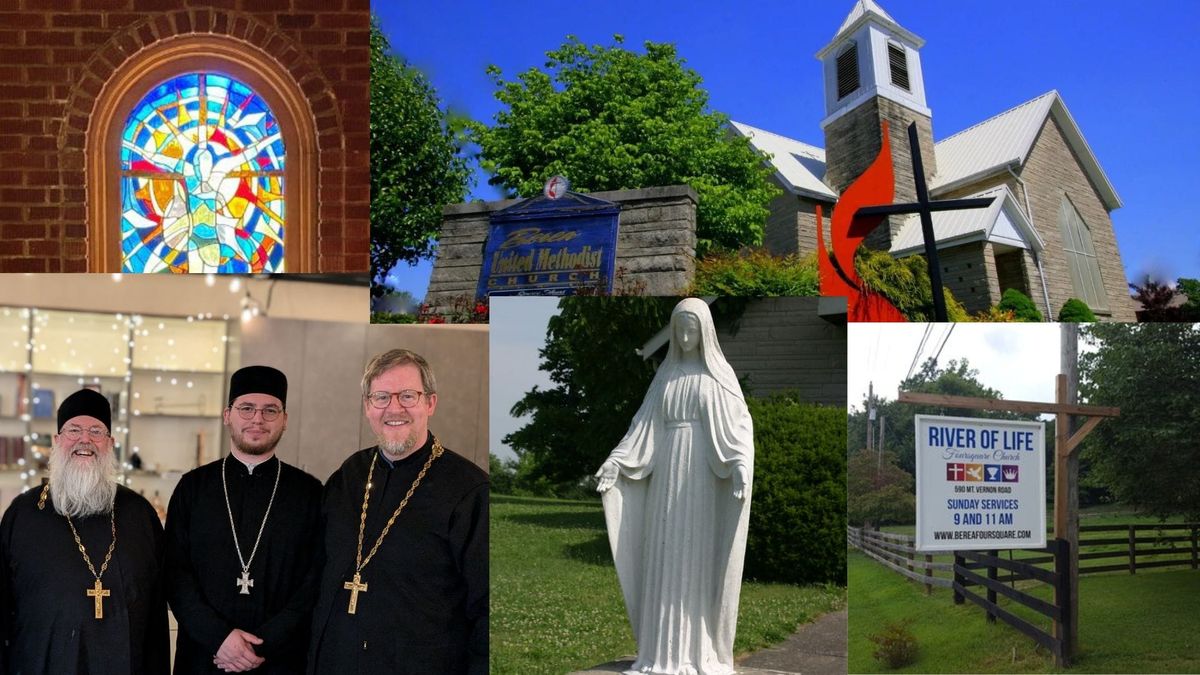
The project is called the Book of Common Good, a riff off of the Episcopalian Book of Common Prayer. The five participating churches are Union Church, Berea United Methodist Church, River of Life Foursquare Pentecostal Church, St. Nina's Orthodox Church, and St. Clare's Catholic Church.
My intent with this community initiative is to leverage what we have in common with our neighbors, in order to penetrate our judgements, silent or spoken, against one another, and forge bonds of care instead. What more people have in common than not in Appalachia is their faith, however it is expressed.
So, I wanted to start there.
This project is not really about churches. It is about fostering curiosity and overcoming any ready-made narratives about others in our community before we have had the direct experience of the truth of their lives. Judgements are useful, but they also have the potential to diminish others into rough caricatures.
When we know the details that hold meaning for someone, it's hard to dismiss them as "one of those people" and it becomes easier to hold them in view as they truly are: our neighbor. And not just our neighbor, but one who worships at this specific church, with its specific hand carved crucifix, where she likes to sing this particular hymn because she learned it from her Papaw shortly before his death, and who makes this particular squash casserole for potlucks.
It's developing this kind of specificity that is key to how this project is structured. Specifics are what bust up broad stroke judgements.
At least two "ambassadors" from each church are assigned the task of attending one service and fellowship event at each of the other four churches. They are to introduce themselves to at least two or more church-goers at the churches they visit, and then report back to their church family and to The Edge the specifics of their experience: what did they like about the service? What surprised them? What felt familiar? What, if anything, did they find upsetting, and why? What questions do they have? The Edge will publish profiles of each church, that includes the anonymous feedback from the ambassadors.
At the end of the year, we will convene all participating congregations for a potluck supper that is partially catered, featuring a panel of the church clergy who will share what their church learned as a result of the project, and who will answer any questions that came up over the course of it.
As the instigator of this, what I am viewing as a radical act of civic reporting, I will also attend services at all five churches. To date, I have been to Union, St. Clare's and River of Life, and have been thrilled to sing full throated along with the congregants at each, where different styles of praise music are central to their respective services.
At the end of the year, I will survey the participating clergy, the ambassadors, and a sample of congregants from across the five churches in order to write a white paper on the overall findings. I look forward to sharing more with you over the next several months.
There is more to the back story of this initiative. This project is, for me, an act of protection—not through regulation, walls, or isolation, but through relationships.
I have become increasingly concerned about how prepared our community is for an uncertain future. With this project, I seek to highlight and help strengthen our networks of care before they are urgently needed. Whether disruptions are to come from economic instability, natural disasters, war, famine, epidemics, or other shocks, it is our relationships with each other that help resilient communities come out the other side, the importance of self reliance notwithstanding.
Some would say that creating and sustaining these systems of care is the work of the state and federal governments. There are strong arguments for this, since generally speaking, government policies are supposed to create systems that protect the people and create a baseline of support.
With that in mind, what I saw in my previous career as a federal health and economics policy reporter is that when the theoretical abstractions that drive policymaking are applied in practice without being rooted in the specific values of the community most impacted, policies fail.
But my experience also has shown me that our once robust federal disaster response systems, including FEMA, are too broken to be reliable at this point in our history, which is why I predict that increasingly, we are going to find that it is up to each community to grow its support networks from the ground up rather than to accept them from the top down.
Having in place ahead of time a detailed awareness of who we are and what values we share in common will help direct the conversation on how to systematize support without needing outside regulations. I foresee that it will be our encounters with one another now that will connect us in times of trouble, the details we gather ahead of time will protect us, and our shared values will motivate us.
The truth is that I see Berea already does this naturally, more than most other places. It is a natural way of being in our City to be aware of our neighbors and any hardships they face. I saw this first hand after the health crisis I recently experienced. It was a flood of Bereans who arrived at the hospital with food, cheer, and good coffee, ready to sit with me both then, and once I was home.
Yet, this project is not all peace, love, and brown rice. Not all churches I approached wanted to participate, and there is no guarantee that this will work the way I envision it—plenty of people would rather say "ugh" than learn about another's faith tradition. This project will not change their minds.
But there already are at least two precedents in Berea for systematizing a response to common ecumenical concerns: The Berea Food Bank, which addresses hunger in our community and which is supported by a council of local churches; and Room in the Inn, which addresses homelessness during the winter, and which had its start in a coalition of churches. Both projects are now fully self-sufficient, although they still rely on local churches, among others, to operate.
What I think this project adds to those precedents is an ecumenical attitude to the community at the congregant level, not just the clergy.
This is one of two grassroots resilience projects The Edge is currently funded to pilot. I will be telling you more about the second one in the coming weeks.
If you think your church would like to participate, please message me. I am happy to add more to the mix, but would probably want to limit it to eight, just so there is enough time for ambassadors to visit all the churches without being too much away from their home churches.
Sign up for The Edge, our free email newsletter.
Get the latest stories right in your inbox.