Young and progressive, Berea PD has reputation for attracting 'nice guys'
Plus, ICE holds up procedure at the Madison County detention center

Ed. note: This is a three-part series, reporting on the Madison County Citizens' Police Academy and a typical day in the life of a Berea Police officer, as experienced by a reporter who rode along for a day.
Part Two
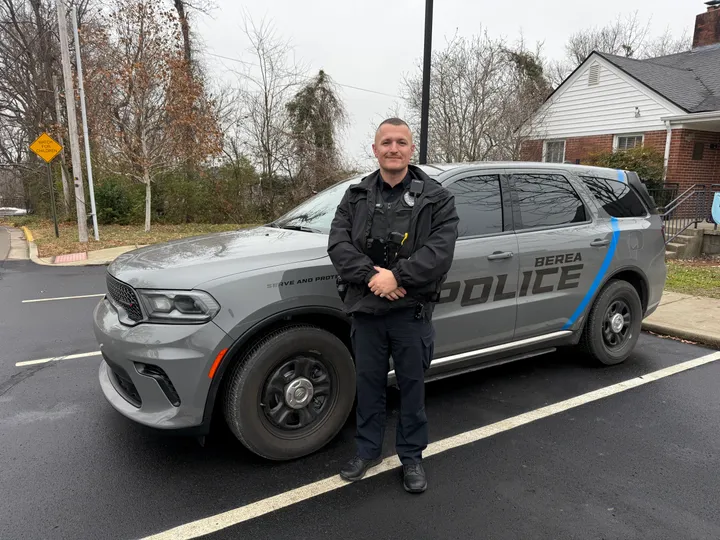
RICHMOND — We were outside the garage bay of the county detention center, waiting for it to open. With our prisoner in the backseat, Officer Josiah McFarland and I had chatted much of the way from Berea to downtown Richmond where the jail is. Mostly he asked me questions instead of the other way around.
He was curious why I wanted to do this, that is, observe how he does his job. I want to add a crime beat to my news outlet, I told him, but I didn't know the first thing about police work. That's why I had attended the Madison County Citizens' Police Academy. That's why I wanted to do this ride-along.
A couple of times, McFarland called out to the man in the backseat. "You okay, X?" That's how I know the man's first name, because of their brief exchanges. Whether or not to use the first names of people we might encounter hadn't been clarified at the start when McFarland had set out the conditions for our ride, but the things I now knew about X were sad. I do not wish to reveal his name. He had no say in my being in the cruiser that day.
At the traffic stop where X had been arrested, I'd watched in the side view mirror from the passenger seat as McFarland had removed everything in X's pockets. X had caught me staring at him and held my gaze for a moment before looking away. How unwell X looked. His skin was sallow, like his blood had stopped moving through his veins, and turned to sludge. He looked as though he'd been unwell a long time. In his mid-30's, he had such low energy.
Later, McFarland told me about X's history. McFarland had arrested him before. The same misdemeanor. X'd been busted for it 20 times, McFarland said. Why isn't he already in jail, I asked, and was told it is at the discretion of the arresting officer. That's not a good system, I said, but then remembered our chronically overcrowded jail.
He also told me about X being very ill. I know, I said. How? McFarland wanted to know. His skin, I explained. Was X diagnosed with a serious chronic disease first, and that had led to the drug abuse? Or was the disease a terrible outcome of the drug use? Whichever it was, we were talking about a dead man walking, McFarland said. A man who'd just been busted for the 20th time for driving on a suspended license, on his way to work, and inside his pocket had been three hypodermic needles, one filled with blood. It had been a work truck, and it had been towed. I reckoned he would likely lose his job.
But for now, he was sitting in the back seat of McFarland's cruiser. Quiet, invisible behind the thick, clear divider between the front and back seats. He had barely answered McFarland's questions about his welfare. "Fine," he'd said.
The wait to deliver X was longer than I'd expected and I wondered where the sleepy-voiced woman who'd initially spoken to McFarland through the intercom had disappeared to. Finally, I asked McFarland what the hold up was.
"ICE is in there," he said. How did he know that, I wondered. The woman through the intercom hadn't said anything about that. I'd never heard the acronym "ICE" come over the communications radio in the car. Maybe one of the many strings of code with multiple series of numbers had referred to the federal agents, and I'd missed it because I don't know police parlance. Maybe it was on his computer screen that faced away from me. Berea cops all have computers in their cars.
"Really?" I asked.
McFarland explained to me that a local law officer had arrested someone who appeared to be "undocumented", so ICE was called in. I asked if the Berea PD had signed the 287(g) agreement with the US Immigration and Customs Enforcement. It's a contract that allows ICE to leverage local law officers for ICE activities. "The what? I don't know," McFarland said.
Even without the contract, ICE agents obviously are in the vicinity, I thought. Days later, I asked Berea Police Chief Jason Hays about it. He told me that Berea does not have such an agreement, that ICE has not been in touch about it, and that Berea has not sought the partnership. "We didn't feel it was necessary," Hays told me. "We had a couple citizens encourage us, but we don't see the need."
The closest ICE satellite office, Hays said, is in Louisville.
At last, the garage door rolled up and we pulled into the bay. It was another wait as X was led into the jail for his booking. He and McFarland disappeared behind a thick steel door as I stayed in the cruiser, per McFarland's and my agreement the I never leave the car unless he had given me permission. Through a rectangular window, I watched a portly man in a dull colored uniform wrap leather and chain restraints around a young woman, maybe an adolescent—I couldn't see either of their faces—who extended her arms for him to thread to her belly. Now restrained, she sat with her back to the window. The man walked away, out of sight.
I looked ahead then, and tried to puzzle out how someone had managed to secure an American flag to the back of the rolling garage door ahead of the car. Wouldn't the flag get caught in the segments? I looked behind me. There was no flag on that door. I pulled out my phone then, and opened my puzzle app. I had finished most of a crossword puzzle by the time McFarland returned. He apologized for the wait. When the garage door opened, the flag rolled with it.
We took Hwy 25 back to Berea. After talking about the woes of X, McFarland said drugs are bad around here. Fentanyl has become a real problem, and meth never seems to go away. Drugs and domestic violence. Those are among the calls Berea cops get the most, McFarland agreed, when I told him that was what another cop had told me. It was sad, he said.
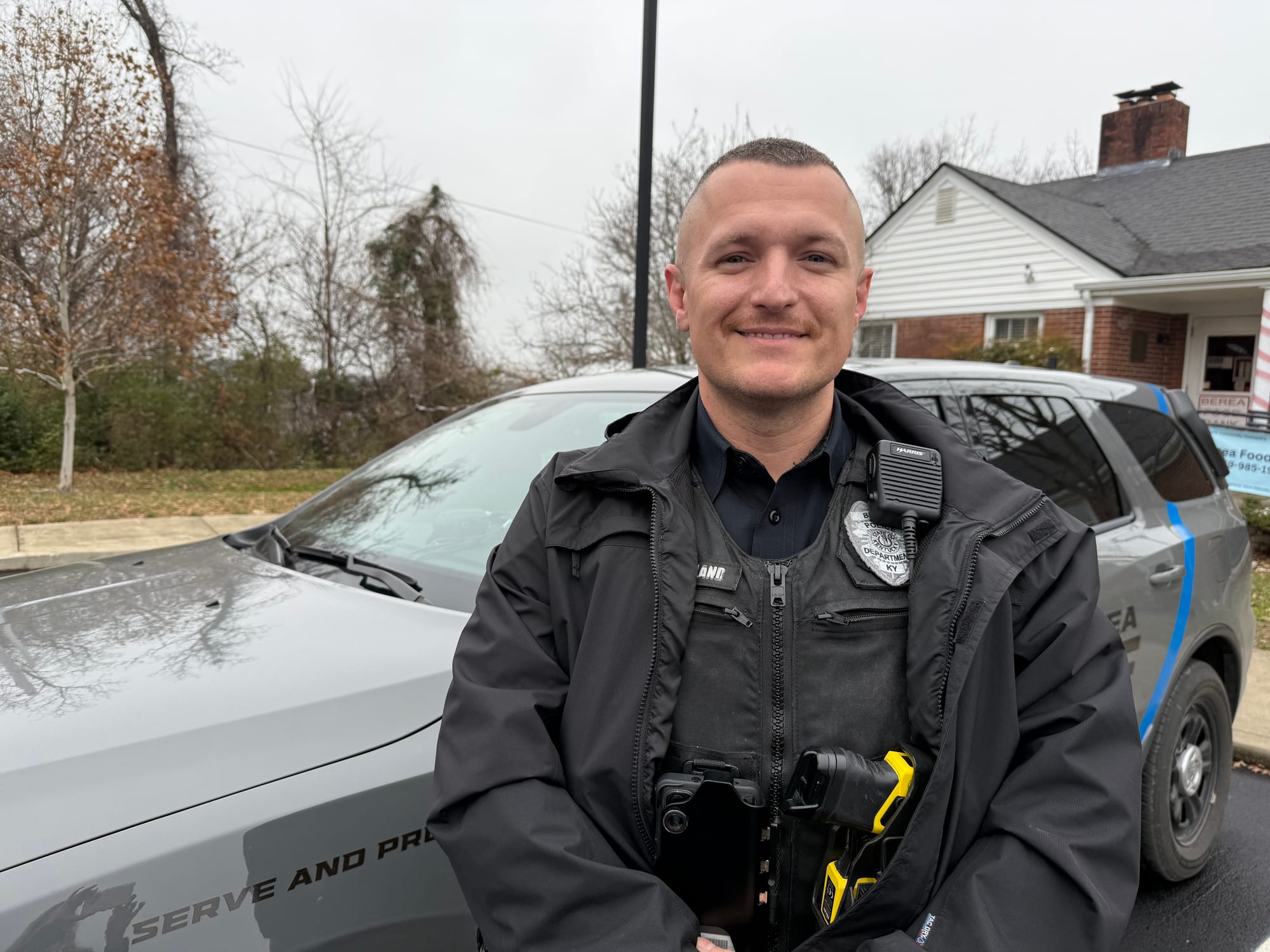
I picked up the thread of a previous conversation that had been interrupted when he'd had to sort out the trespassers in Stoney Creek earlier in our ride-along. How did he end up becoming a Berea police officer, I wanted to know.
He'd been growing restless as he was entering his 30s, is the summary of what he said. At the time, he was a 24/7 medical courier in Lexington, but he wanted to serve something bigger. "I'm healthy, why not me?" he said he asked himself. his older brother had also been a cop, and he admired his brother.
Several of McFarland's Jiu Jitsu buddies were also cops, and they'd encouraged him to check out Berea, assuring him the guys who worked there were happy, that it was the most progressive department around, meaning its leadership is sensitive to the mental health needs of their officers, he said.
Only one regret, he said. "That I didn't do it sooner." McFarland has been with the BPD for about three years.
After re-entering Berea, we turned on 595 and headed West, past the same light where McFarland had arrested X. At the Southbound Exit 77 traffic light, a woman was in a stalled truck. Another officer had responded. McFarland was back up. He directed traffic while the first cop on the scene did the requisite paperwork.
Once back in the cruiser, McFarland said, "great guy" about the other officer, just as he had when yet another cop had stopped to assist him when arresting X.
I mentioned this enthusiasm for one another to Hays, the police chief, when I spoke with him later. "They act like brothers," I said. "Like they're family."
Hays told me that among Berea's 36 sworn officers, which includes himself, there is great comradery, and that even the officers' wives are close to one another. "Especially with us being a smaller agency, we get to know each other," Hays said, noting that his officers will remember the birthdays of the kids of other guys on the force.
I told Hays what McFarland had told me, that Berea has a good reputation, that he, the chief, has a good reputation for caring about his officers' mental health. Hays turned it around to focus on his recruits.
"We are super blessed," he said. "I'm so proud of them. We get so many letters and thank you notes, saying, 'This happened to me, and I just want to say thank you.' So I think a lot of them go way beyond what's expected of them."
I asked if it's a young force. Hays said half his department is under the age of 35.
Next, McFarland pulled into the Shell station just past the highway exit. We'd agreed earlier to have a snack instead of taking time out for lunch.
He likes almonds, I'd noticed. There was a plastic baggie full of them in his cruiser the he munched from. So, I bought some chocolate bars with almonds in them, and a bag of roasted almonds. Also, a couple bottles of water. Once back in the cruiser, I divvied it up. Ten minutes later, I wished I had bought more, but I hadn't known what was to come next.
Next up: how does the Berea PD help the homeless? And, more about the inner workings of the department. To read Part One, visit this link.