EKPC v. Berea College case underway
The utility wants to build a transmission line through the College's forest, the College has to prove why that's abuse
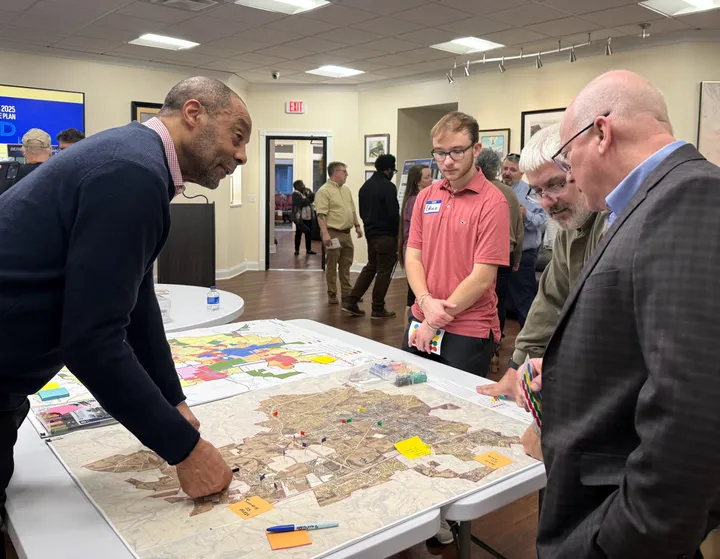
COUNTY COURTHOUSE — Expert witnesses, drone footage, multiple maps and enlarged photos of a historic forest, and an offer to construct a prairie of native grass featured in the opening day of a local land use case that has garnered attention in Berea and beyond, in part due to the potential threat to several beloved landmarks posed by the development of a new power line.
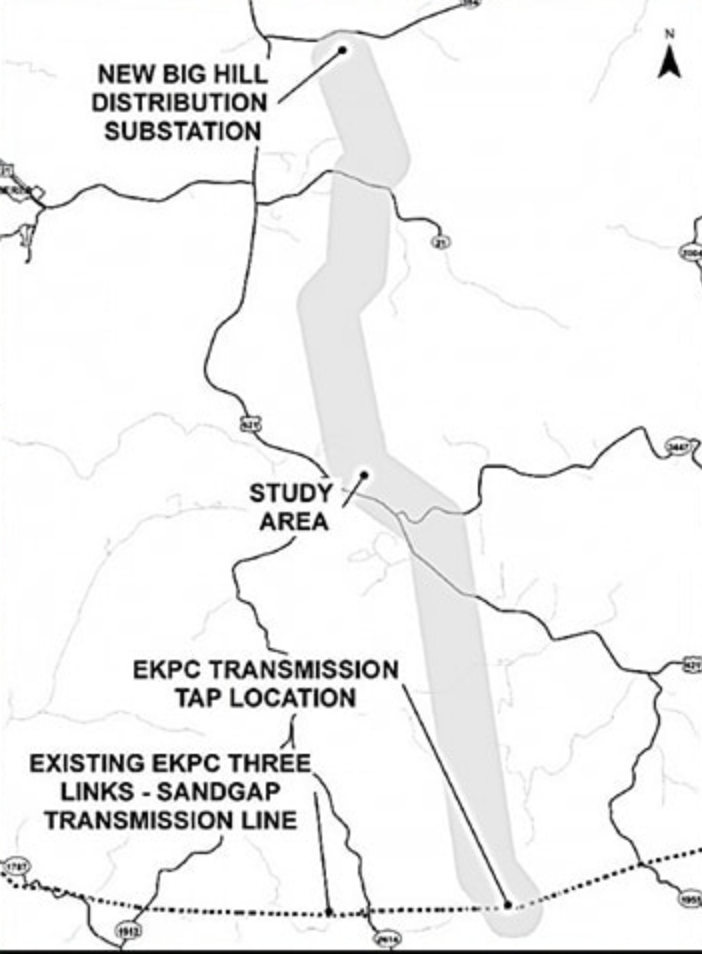
Last year, East Kentucky Power Cooperative attempted to negotiate with the College for the right to build a roughly one mile long, 100-foot wide clearing through the Berea College Forest, in order to construct 8.5 miles of a brand new transmission line. Their demand was met with outrage by College officials who refused to negotiate unless the utility provided evidence it had explored options other than to build through the forest. That never happened.
The utility says it needs to build the line to ensure reliable service for residential customers in the Big Hill and Red Lick areas outside of Berea. What's at stake, according to the College, isn't just "land" but a "living classroom" in one of the nation's oldest sustainably managed forests.
"There are many land owners who feel their forest is special," Medrith Lee Norman, counsel for East Kentucky Power Cooperative, said as the case got underway.
To win the case, Lexington-based attorney Joe Childers, who is representing the College, must prove EKPC somehow abused its power of discretion when deciding to build the new line through the College's 9,300 acres at the southern end of Madison County.
'High burden' of proof
"We've identified the needs, following prudent engineering," Norman said in her opening argument. "We're given the right to take in order to provide consistent power ... [Childers] needs to prove we didn't use our discretion properly. That's a high burden," Norman told County Circuit Court Judge Kristin Clouse, during her opening argument.
The state gives the benefit of the doubt to utilities in eminent domain cases, citing their land takings as being in the public good, provided there was nothing fraudulent or abusive about the decision to take the land. In 2023, the Kentucky Supreme Court heard a case challenging this standard. In that proceeding, property owners in Boone County sued Duke Energy which sought "unlimited access" to their properties for a power line development. The plaintiffs argued the utility should have to prove the need to take the land, and that it be limited to what was necessary. There was no ruling in the case, as the parties settled out of court.
'There were alternatives'
Brown Thornton is a Tennessee-based energy infrastructure consultant who previously worked for the Tennessee Valley Authority. He was the first witness called by the College. Thornton's testimony had been given via a deposition the day before, and presented to the court in a video. In it, Thornton sat for over three hours, answering Childers' questions about power circuits, voltage, capacity, load, and circuit breakers on transmission lines.
This was all in the context of several exhibits presented by Childers, showing maps of existing EKPC transmission lines and substations that might be modified to provide power to southern Madison County. Ultimately, Thornton averred that EKPC's current project is acceptable, but testified that were the utility to leverage current infrastructure, it would save several million dollars in construction costs, and would shorten construction time.
Specifically, Thornton said a 4.4 mile long line running south from the 69 kilovolt line that connects the West Berea and Duncannon Lane substations, could be built and connected to the existing line. Breakers could then be positioned around where the new line would connect. This would protect the new line if the main line were down, and vice versa. Thornton testified that this option would cost just over $8 million compared to the roughly $12 million price tag on the current project.
Another option Thornton offered was to build two new transformers at the Hickory Plains substation which the utility argues is overloaded as it serves 4,100 meters. The new transformers, according to Thornton, would increase conductivity by 25%. With the new transformers, a transmission line could be built from Hickory Plains south, to a new Big Hill Line substation on Red Lick Road. This would allow EKPC to deliver the 8 to 10 megawatts needed to serve the 1,500 residential power co-op members in the region, Thornton said.
"It would be a solution to the problem, but it doesn't appear they considered it," Thornton testified. He also testified that it did not seem that EKPC had included public input in their planning, which he said was not "best practice".
During cross examination Norman found multiple ways to ask if Thornton was saying that EKPC engineers did not know what they were doing, which Thornton denied.
'We'll build you a prairie'
Childers next called to the stand, Berea College Forest manager, Clint Patterson. Over about an hour of testimony and cross examination, replete with drone footage of the forest, several maps showing where the transmission line would be built as evidence submitted mainly by Childers, Patterson described what would change irreparably once the line was built.
These disruptions include the dark sky telescope observational site built next to the Windswept conference facility that overlooks Owsley Fork and the knobs in three directions. That view, which Patterson said had been the driving force in the decision to locate Windswept there–would also be altered. The building was designed by a student of architect Frank Lloyd Wright, he added.
Patterson spoke at length about how the forest, which pre-dates the entire National Parks system, is frequented by students and hikers, and that it was always intended for recreation.
Patterson also said the line would change how the forest is maintained, interfering with its standing as the second oldest sustainably managed forest in the nation. The College, he said, uses prescribed burns as part of their forest management techniques, but that the 100 foot easement for the line would make this difficult to do.
Patterson also testified about how the College had recently purchased some land in the northeast portion of the forest in order to create a contiguous footprint for the forest. "Ironically, the line would go right through that land where we planted native prairie grass," Patterson said, adding that the restored grasslands have attracted a profusion of Monarch butterflies. The US Fish and Wildlife Service have suggested Monarchs be placed on the Endangered Species list.
During cross examination, also Norman submitted a map of the forest that was slightly different than the College's and asked Patterson if the College had ever called EKPC to ask them to build a native prairie for them. "Wouldn't you like that? That is the kind of thing we will do," she said. Patterson hesitated several beats before saying, that no, he didn't know about any requests for a prairie.
Norman also suggested that hikers and others would not be disturbed by the easement. "We're not dividing it so that people can't walk across it. Won't you emerge from the shade and into the sunshine for a moment and then walk back into the shade?"
Norman ended her cross examination of Patterson with an interrogatory statement: "You don't doubt we're doing this for a good reason."
'That would work'
Childers' last witness was Bluegrass Energy's vice president of engineering, Chris Brewer. Bluegrass Energy is a member-distributor co-operative of EKPC, which generates and transmits the power used by 16 member co-ops. Brewer testified he had been involved in choosing the site for the substation planned for Red Lick Road.
"We don't pick the routes, but we choose where the substations will go," Brewer said. He testified that the Red Lick Road location was chosen because it is close to BGE's distribution lines, since reliability is the main concern.
When Childers asked Brewer to evaluate the two alternatives Thornton had suggested, the witness said the breakers surrounding a new line would work. Childers released Brewer at that point. Norman said she had no questions.
A ruling is expected in the next several weeks, after another day of arguments and witness testimonies, including that of EKPC's transmission planning manager. Court begins at 9:00 AM, in the Madison County Courthouse's Circuit courtroom, and is expected to go through the afternoon.
This story has been updated to reflect the ruling will be returned in several weeks.
Sign up for The Edge, our free email newsletter.
Get the latest stories right in your inbox.