Non-industrial jobs, youth activities, housing top concerns in Comprehensive Plan survey
Plus, what would it take for Berea to have a Trader Joe's?
BEREA—Finding a good job, something to do, and a place to live were top of mind for a large majority of Bereans surveyed last year about the City's land use and other policies that impact quality-of-life, according to consultants.
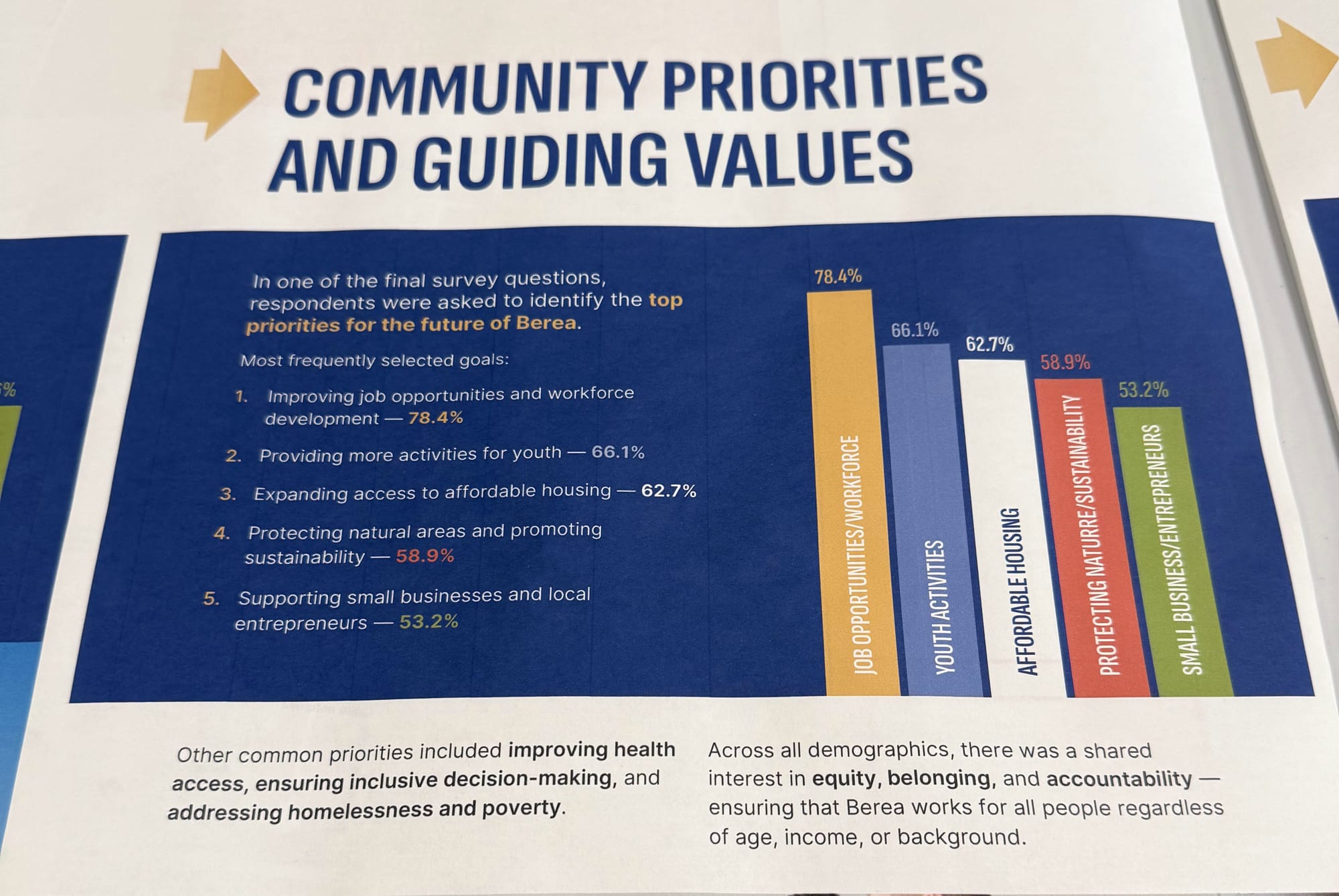
In a presentation of data collected on behalf of the City of Berea for its Comprehensive Plan 2025 initiative, Lexington-based EHI Consultants showed that good jobs ranked most important for 78.4% of those surveyed. Providing more youth activities ranked second at 66.1%, and expanded access to affordable housing came in third at 62.7%. The data were presented in a public open-house meeting at the Berea Gallery on Thursday.
Rounding out the top five priorities were protecting Berea's natural areas and promoting sustainability, and supporting small businesses and local entrepreneurs.
One item that stands out, according to Ed Holmes, EHI's president, is that a town the size of Berea does not have a recreation center. Berea's population is roughly 16,000. "A comment made to us is that the college's facilities aren't accessible to the public," he said. "We are going to meet with Berea College to verify that."
Otherwise, according to Ryan Holmes, EHI project manager, "We weren't really surprised by the data. This is what we expected from what we were hearing throughout the process," he told The Edge at the meeting. Ryan Holmes also said that the meeting with the College will focus on ways to overcome the "town and gown" effect where the town and the college do not interact much. "We want to help bring the two together," he said.
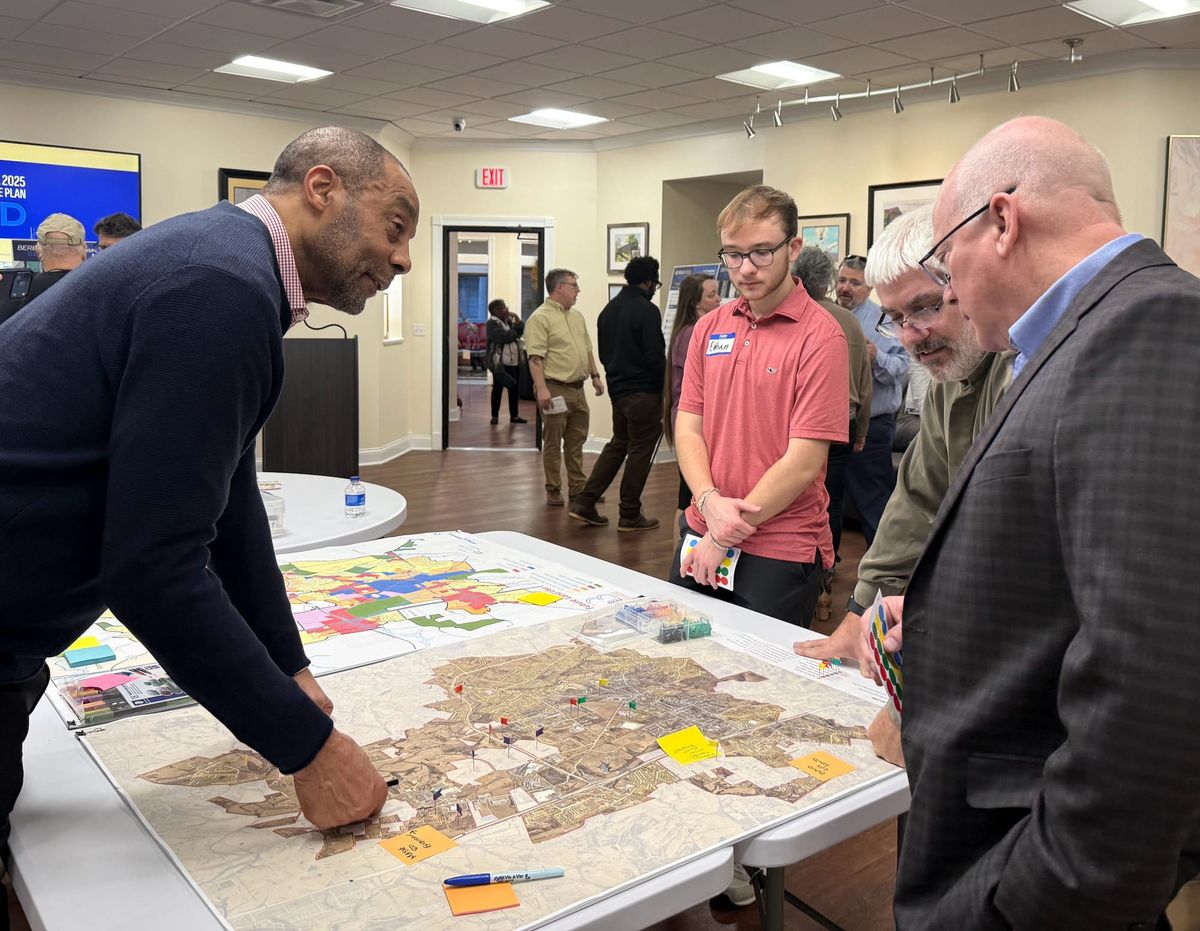
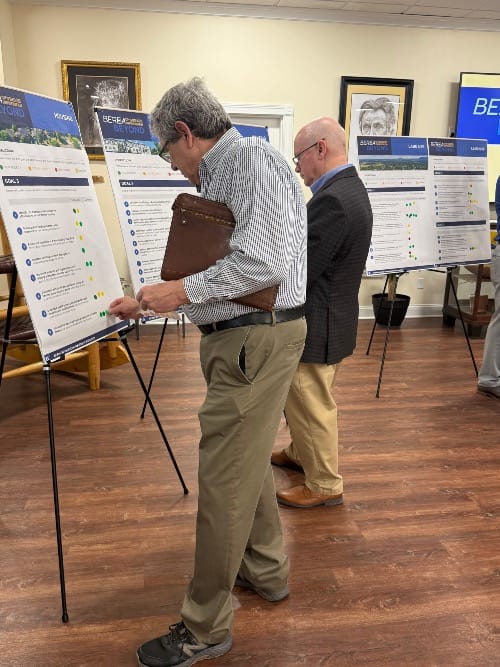
Thursday's meeting was to present the results of the survey, and to offer residents an opportunity to fine tune those results with what they wanted to prioritize. To that end, attendees were given colored sticker dots to place on posters of the results, in order to color-code their priorities. Results of Thursday's meeting will be reported in the Spring.
Youth Engagement Survey
A separate Youth Engagement Survey was completed by 72 Bereans age 18 years or younger. Nearly three-quarters (72%) ranked having an indoor sports and recreational facility as their top priority. Just over 61% said they'd like to see a youth center in town. Safe spaces to hang out was ranked third at 58.3%. Nearly half (48.6%) wish to see improved park infrastructure, while more than a third (38.9%) would like a facility where teens can enjoy live events including open mic nights. Exactly a quarter (25%) of those surveyed sought job training or internships.
Virtually half (48.5%) of young people surveyed were ambivalent about their chances of staying in town post-high school graduation. The other half said they would stay. What would make them stay, according to open-ended questions on the youth survey, were more job opportunities, affordable housing, and entertainment opportunities, in that order.
Survey process
In all, there were 660 respondents, including 110 citizens 18 years of age or under who took the Youth Engagement Survey. Tallies for the youth survey were made when that number was only 72 respondents, as the online survey is still live at Berea2025.org
"That's a relatively good number," Ed Holmes, president of EHI, told The Edge in a phone interview. "We don't get that many in Lexington for some of the projects we do there." He added that, typically, a response of between 1% to 3% of the population is considered normal.
Surveys were completed in person at the Spoonbread Festival last year, and online at Berea2025.org. Additional data were collected by EHI during last year's Comprehensive Plan kick-off meeting in May. At that meeting, citizens were asked to color-code their priorities for the City across a range of topics, including but not limited to housing, labor, recreation, and education.
Feedback collected from citizens during the first Comprehensive Plan public meeting was not included in the survey data, but was included in the overall data collection, according to Ryan Holmes. Youths were welcome to participate in both surveys.
Berea's quality-of-life
Just under a quarter (23.7%) of those surveyed rated Berea an "excellent" place to live. Most respondents (45.6%) thought Berea was a "good" place to live. About one in five (21.1%) rated Berea as a "fair" place to live, while 7.6% said it was a "poor" or "very poor" place to live.
More than a third ( 38%) of respondents were between the ages of 35 and 54. The next largest group at 27% were seniors (55-74). Third were 18-34 year olds (26%). Those older than 74 comprised 5.5% of the respondents, with 3.5% being 18 or younger. Homeowners were 65% of respondents, with 30% being renters. The remaining 5% lived in a variety of situations.
Those under 35 tended to express more frustration with Berea, citing its lack of affordable housing, lack of jobs, and limited entertainment venues, according to the EHI report. Older home-owners tended to be more favorable in their assessment of Berea than did renters, according to the report, that also stated that both "praised parks and local culture."
Industry ranks fourth for economic development
About 10% of Berea's 10,000 acres are set aside for industry, and there are several hundred more for mixed use commercial, which can include industrial development, yet the importance of industrial jobs did not rank at the top of respondents' concerns.
"We're still working on the land use analysis, but there are about 1,000 acres zoned for industry, but that might include flood plains, and so on," Ed Holmes told The Edge in the interview. "We should know by mid-April."
When asked what sorts of economic development and job creation they would like to see in Berea, less than half (46.9%) of survey takers listed light manufacturing or artisan craft jobs as their preference, putting this option in fourth place. Leading the list was a demand for Berea to have more restaurants (71.6%). Second in demand were more retail shops (65.4%), and third were more workforce development centers (54.2%). Farmers markets and locally based food businesses came in fifth (43.1%).
Ed Holmes told The Edge that when compared with cities of comparable size, such as Danville, "Berea has a lot of industrial land. Berea's industry is also more regionally based, while Danville's is more locally based." He said that the survey turned up that there is a small number of people from Lexington who commute to jobs in Berea's industrial parks.
Industrial jobs tend to pay better wages than retail ones, which often start at or just above minimum wage and do not include benefits. Many entry-level industrial jobs start around $35.00 per hour, and include benefits.
Mixed-use development a priority
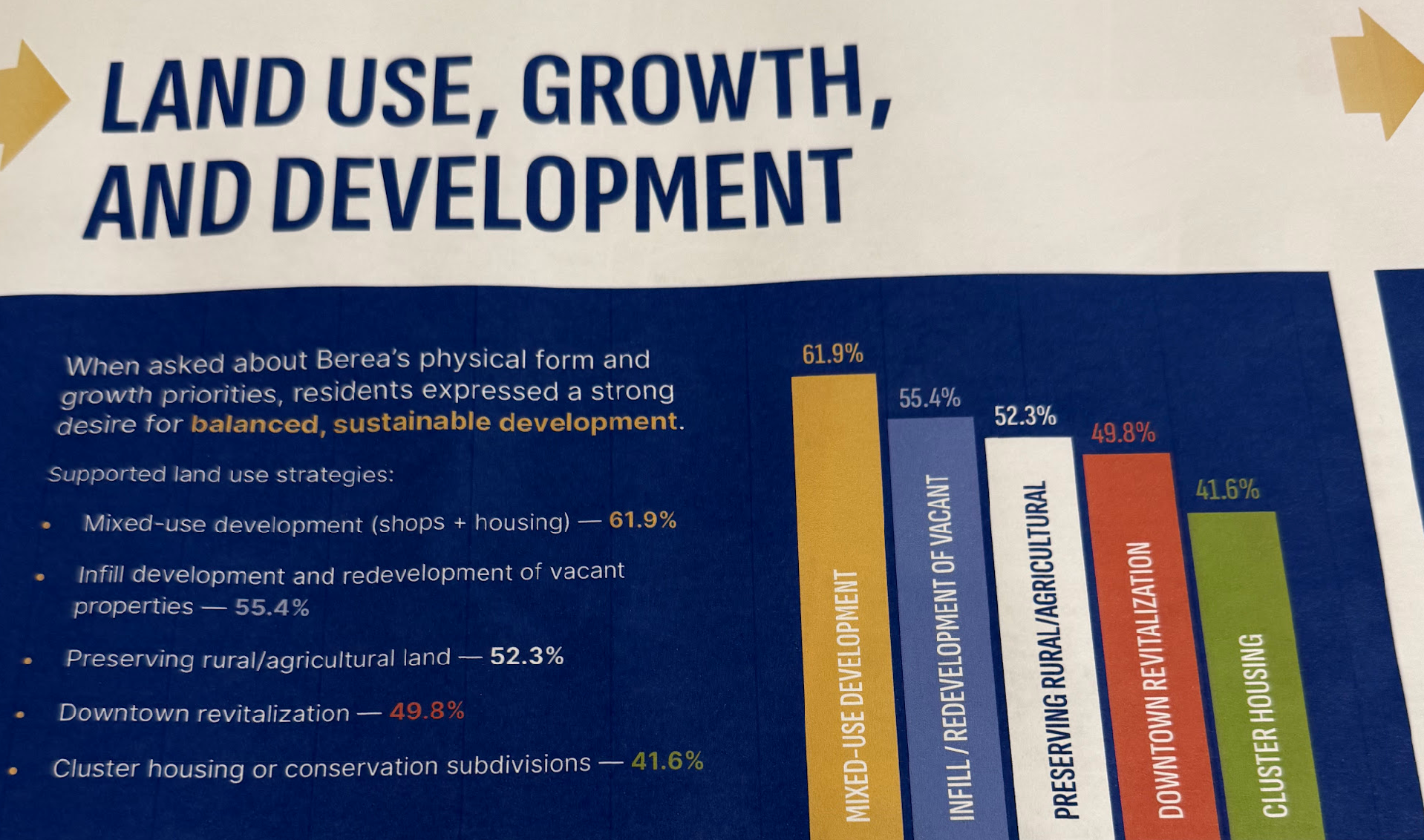
Further, Bereans expressed "a strong desire for balanced, sustainable development" according to the data presentation. While a need for industrial parks did not rank anywhere in the list, about two-thirds (61.9%) of respondents placed an emphasis on mixed-use projects. These could include multi-story buildings with storefronts on the ground floor, and living units above, according to Martin Richards, Berea's Planning and Zoning vice chair.
"If we had more housing, then folks who are filling the jobs that are created and who also want to live here, can do that," Richards told The Edge during the meeting. "Then you start getting the economic multiplier effect." He added that to accommodate more housing on our limited amount of land, the City should consider building multi-story buildings. "Then people can live near where they work," he said.
This vision would be easier to realize if the City could broaden its focus to include mixed use building in addition to industry, according to Richards. "All these things are interconnected. If we're going to create more jobs, then let's create the things that support those jobs," he said.
To realize some of the larger retail opportunities Bereans say they want, Richards said our population would need to increase. "We all want retail, we all want more restaurants, and they want to work there, according to the surveys. But the only way to create that reality is to increase the population," he said. "People are always talking about wanting a Kroger's or a Trader Joe's, but they aren't coming here because we haven't reached the demographics they want."
Richards said that in the meantime, for local entrepreneurs, he believes there is more Berea can do to help mitigate the risks of starting a local business.
The other land use priorities for citizens, according to the survey include infill and redevelopment of vacant lots (55.4%), agricultural and other rural land preservation (52.3%), downtown revitalization (49.8%), and creating conservation-conscious subdivisions, aka "cluster housing" (41.6%).
For now, housing that is affordable topped the list of concerns to do with housing in Berea. Two-thirds (66.2%) of respondents decried elevated rents and home prices, "even for modest dwellings", according to the survey. Senior housing was also highly ranked as a concern for nearly half (48.4%) of those surveyed. Thirdly, at 41.7%, was an expressed need for accessible housing for the disabled. More than a third (38.2%) of first-time buyers complained there aren't enough starter homes, while a similar number (34.5%) who rent expressed frustration that rents are too high here.
Data centers
Missing from the data, according to Ed Holmes, is any expression of concern about data centers. "But we started these surveys about a year ago, and they weren't much of an issue. Now they are popping up everywhere," he said in the interview. "We are going to recommend we talk about data centers in Berea's land use program. The harmful impacts of data centers are huge," said Ed Holmes, who sits on a special committee in Frankfort, dedicated to data centers and their impact on utilities. He referenced another community where he is a consultant. "I suggested to the people in Franklin (Ky.) that they assess a one million dollar impact fee for all the harm to roads, water, and sewer, but I never heard back," he said.
The Edge previously reported on how out-of-state developers seeking to build a data center on 200 acres in Franklin are now suing Simpson County where Franklin is located, after local county officials attempted to block the project with retroactive data center regulations.
'Berea is special'
"It's been enjoyable working with Berea," Ed Holmes said. "The people here are paying attention and have valuable input. I'm excited to work with Berea because there is something here, I don't know what it is, but the culture includes a sense of caring and community that I don't see everywhere. I noticed that about Berea from the very beginning. We want to help create a Comprehensive Plan that protects that specialness."
According to Ryan Holmes, "We are targeting April for our next public meeting, which will place a large emphasis on future land use, and our intent is to design a workshop around that theme."
Sign up for The Edge, our free email newsletter.
Get the latest stories right in your inbox.